
An insurance policy is one of the most significant financial documents you will ever sign. An insurance policy is a legally binding contract between you and an insurer that protects you against specific risks in exchange for payment. You can protect your health, home, vehicle or future of your family or dependent. Even though having insurance is so prevalent in our daily life, a good chunk of millions of humans do not entirely know how an insurance policy works, what it covers and how to select one. In-depth guide to help you understand an insurance policy to make informed choices.
What Is an Insurance Policy?
An insurance policy is a documented contract between an individual (the named insured i.e you) and the insurer (the insurance company). The insurer promises to pay your losses, damage, sickness or death in exchange for regular payments called premiums. Insurance policies include certain terms, conditions and what is covered or not covered.
Your insurance policy is not something you can opt out of fully understanding. The difference between a properly covered claim and an expensive writing grief could be reading and copying the policy itself.
Key Components of an Insurance Policy
There are a few key components common to every insurance policy no matter the type. Familiarising yourself with these areas will allow you to compare options and make sure there are no hidden surprises.
| Component | Description |
| Premium | The amount you pay periodically (monthly/annually) to keep the policy active |
| Sum Insured / Coverage Limit | The maximum amount the insurer will pay in case of a claim |
| Deductible / Excess | The amount you pay out-of-pocket before the insurer pays the rest |
| Policy Term | The duration for which the insurance policy remains valid |
| Policyholder | The person or entity who owns the insurance policy |
| Insured | The person(s) covered under the insurance policy |
| Nominee / Beneficiary | The person who receives the claim payout |
| Exclusions | Situations, conditions, or events not covered by the insurance policy |
| Waiting Period | Time after buying a policy during which certain claims cannot be made |
| Grace Period | Extra time given after a missed premium payment before policy lapses |
Read Also:- United India Insurance | Max Life Insurance | Policy Bazaar
Types of Insurance Policy
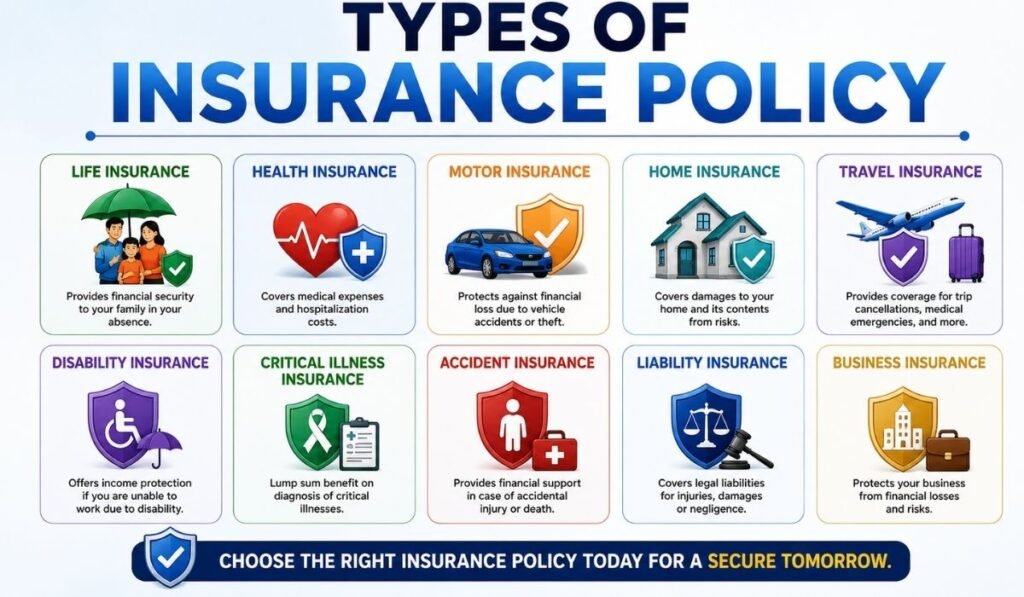
There is an insurance policy that can cover almost every single aspect of life. Here are the Top Level categories:
1. Life Insurance Policy
The nominee receives a lump-sum death benefit from a life insurance policy if the insured dies while the policy is active. It comes in several forms:
- Another example of a pure insurance plan is Term Insurance – which provides you basic protection for specified tenure and is the most inexpensive kind of policy.
- Universal Life Insurance – Provides lifetime coverage for the insured
- Endowment Plans – Combines savings with life coverage
- ULIPs (Unit-Linked Insurance Plans) – Combines investment and insurance
2. Health Insurance Policy
Meanwhile, a health insurance policy provides benefits against medical expenses or hospitalisation, surgeries and also outpatient treatment under certain policies. In this age of soaring medical costs, it is maybe the best type of insurance policy that you can get.
3. Motor Insurance Policy
Most of the countries including India have made motor insurance policy legally compulsory. It safeguards your car from accidents, thefts, natural disasters and third-party liabilities.
4. Home Insurance Policy
Home insurance protects your house and personal items from fire, floods, thefts, earthquakes and other risks.
5. Travel Insurance Policy
Travel insurance is a policy that provides financial protection against trip cancellations, medical emergencies while traveling overseas, loss of baggage and delay in flights within the country or abroad.
6. Business / Commercial Insurance Policy
Commercial insurance protects businesses from losses due to various types of risks, such as those arising from property damage, legal liability (lawsuit), employee-related risks and business-opportunity losses.
Read Also:- PNB HRMS | New India Assurance | MEDISEP
How Does an Insurance Policy Work?
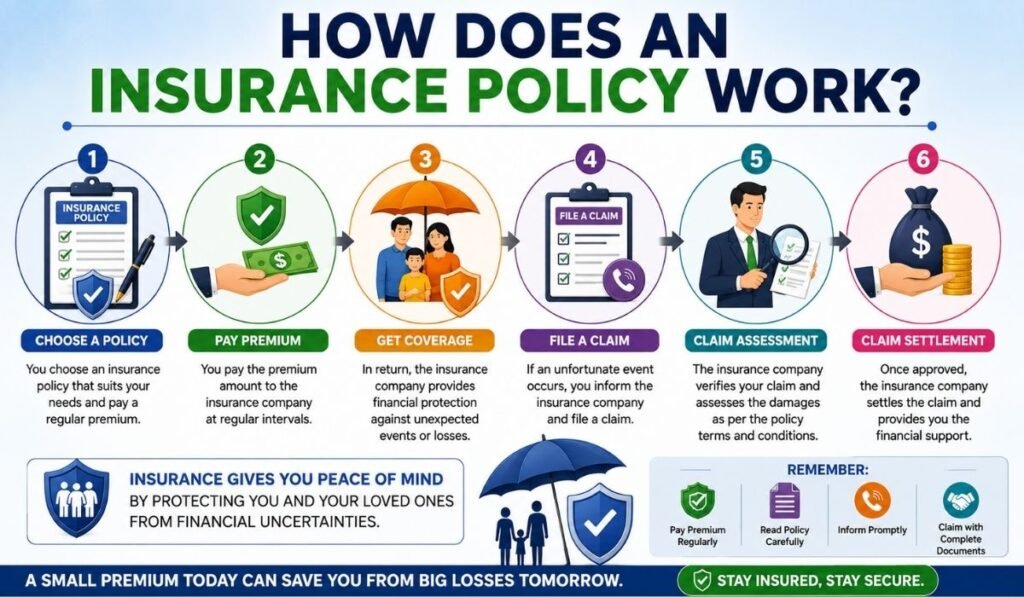
The key essential to the working mechanism of any insurance policy is risk pooling.
- You pay a premium and buy an insurance policy.
- Thousands of policyholders pay premiums to the insurer.
- In case of any eventuality (accident, illness, death) covered under the plan you make a claim.
- The insurer checks the claim against your policy terms.
- Compensation, if approved, is reimbursed for up to the sum insured.
The process of the insurance policy from start to finish must conform to utmost good faith honesty and transparency on both parts as well.
Premium Calculation: What Affects the Cost of an Insurance Policy?
Insurance companies evaluate risk at the stand before quoting an insurance policy price. Here are the main factors:
| Factor | Impact on Premium |
| Age | Younger individuals pay lower premiums |
| Health Condition | Pre-existing conditions increase health policy premiums |
| Occupation | High-risk jobs increase premiums on a life or accident insurance policy |
| Sum Insured | Higher coverage = higher premium |
| Location | Flood-prone or crime-heavy areas raise property policy premiums |
| Claim History | Past claims can increase renewal premiums |
| Type of Policy | Comprehensive policies cost more than basic plans |
| Add-ons / Riders | Each additional rider increases the insurance policy premium |
Inclusions and Exclusions in an Insurance Policy
One of the features of any insurance policy which is usually much ignored are its exclusions means what it does NOT cover.
Common Inclusions
- Accidental death or disability
- Illness or Injury that Requires Hospitalisation
- Property damage due to natural disasters
- Third-party vehicle damage (motor policy)
Common Exclusions
- Pre-existing conditions (during waiting period)
- Suicide or self-harm (first year of life insurance policy)
- War, Nuclear Danger or Terrorism – Most policies
- Driving under the influence of alcohol or an uninsured motor (motor insurance policy)
- Cosmetic Or Optional surgery (Sure fit future benefits)
Read the Exclusions section of your insurance policy before signing on.
How to Choose the Right Insurance Policy
Takes time to choose the right insurance policy. Follow this step-by-step approach:
- Evaluate Your Requirements – there are risks you can insure for (health, life, property, vehicle)
- Compare Multiple Policies – Never ever buy the first insurance policy you gaze. It compares features, premiums, and claim ratios.
- Verify the Claim Settlement Ratio (CSR) – The greater the CSR, the more claims an insurer settles. Find a life insurance provider with 95%+ CSR.
- Know the Terms – Go through each of the clauses in your insurance policy document thoroughly.
- Make Use of Add-on Riders – Use them for critical illness cover, accidental disability rider etc. to supplement your base insurance policy from time to time.
- Verify the Network – When choosing a health insurance policy, ensure that hospitals of your choice belong to the insurer’s network.
- Review Annually – As life changes, so do your insurance policy needs. Review and upgrade as needed.
Claim Process for an Insurance Policy
If you know how to do it the right way then filing a claim under your insurance policy should be a piece of cake.
| Step | Action Required |
| Step 1 | Notify your insurer immediately after the event |
| Step 2 | Fill out the claim form provided by the insurer |
| Step 3 | Submit required documents (medical reports, FIR, bills, etc.) |
| Step 4 | Insurer investigates and verifies the claim |
| Step 5 | Claim is approved or rejected based on insurance policy terms |
| Step 6 | Payout is made to the policyholder or nominee |
Having digital copies of your insurance policy as well as all relevant paperwork expedites the claims process.
Insurance Policy vs. Assurance: What’s the Difference?
There is a lot of confusion around insurance and assurance. Here’s a clear breakdown:
| Feature | Insurance Policy | Assurance Policy |
| Coverage Event | Uncertain events (fire, accident) | Certain events (death, maturity) |
| Policy Term | Fixed period | Long-term or whole life |
| Payout Trigger | If the event occurs | When the event occurs |
| Example | Health, motor, home policy | Whole life insurance policy |
Tax Benefits of an Insurance Policy
The tax benefits of an insurance policy in India are also very attractive under the Income Tax Act, 1961:
- Deduction under Section 80C for premiums paid for life insurance policy of up to ₹1.5 lakh
- Section 80D – Premium paid for health insurance policy (self up to ₹25,000; senior parents up to ₹50,000) is deductible
- Section 10(10D) – The proceeds from a life insurance policy which become receivable upon maturity or death is exempt (from tax subject to conditions being satisfied).
These tax benefits turn an insurance policy not just into a protection tool, but also make it a very useful financial planning instrument.
Common Mistakes to Avoid with an Insurance Policy
- Underinsure – Going for a lower sum insured to save on premium
- Failing to Reveal Medical History – It can lead to rejection of claim on health or life insurance
- Falling behind on Policy Renewals – An inactive policy insures you nothing
- Buying Without Comparison – Missing out on better options available in the market
- Not Updating Nominee Details: Outdated nominees have the potential for dispute in the settlement of claims
FAQs
Q1. What is the minimum age to buy an insurance policy?
Generally, you can only get a life insurance if you’ve reached the age of at least 18. But in reality, depending on the insurer, there are health insurance policies or child plans that can cover children even from birth.
Q2. Can I have more than one insurance policy?
Yes you can have different insurance policies active at the same time. For example, if you have two health insurance policies, claims can be made from both in a ratio. Multiple policies are completely allowed for life insurance.
Q3. What happens if I miss a premium payment on my insurance policy?
The majority of insurers gives you a grace period (typically 15–30 days) after the due date. Your insurance coverage remains in effect if you make your payment during this period. After the grace period, your policy might lapse and you lose coverage until it is reinstated.
Q4. How do I check if my insurance policy is genuine?
You can check this on the official website of Insurance Regulatory and Development Authority of India (IRDAI) or directly through your insurer’s portal. The policy document should have a unique policy number and an official stamp of the insurer.
Q5. What is a free-look period in an insurance policy?
The free-look period (typically a 15–30-day limit from the date you receive the document) allows you to revoke your newly bought insurance policy because you’re not happy with the conditions and land a full or partial refund of the premium charged.
Q6. Is an insurance policy transferable?
An insurance policy is usually not transferable from one person to another. Unlike a life insurance, both whole and term plans but more importantly than that any type of motor insurance plan gets transferred from seller to buyer when an automobile sold ideally within the time frame set by regulations for changes in ownership as per process mandated.
Conclusion
Insurance policy is much more than a mere paper, it is like a financial pillow that cuddles you and your dependence whenever life risks happen. There are many types of insurances; from a basic motor insurance policy to an extensive life insurance policy each has its unique and vital role. This means reading your policy, picking coverage that is best for you, and reassessing it when your life changes.
Spending time today to understand an insurance policy can avoid devastating financial consequences tomorrow. Having the right insurance policy can give you peace of mind before any crisis hits, so do not wait for a crisis to learn about your coverage gap.
Protect your business with the right coverage. Explore our Corporate Insurance Policy guide to understand business insurance plans, benefits, and coverage options for companies of all sizes.