
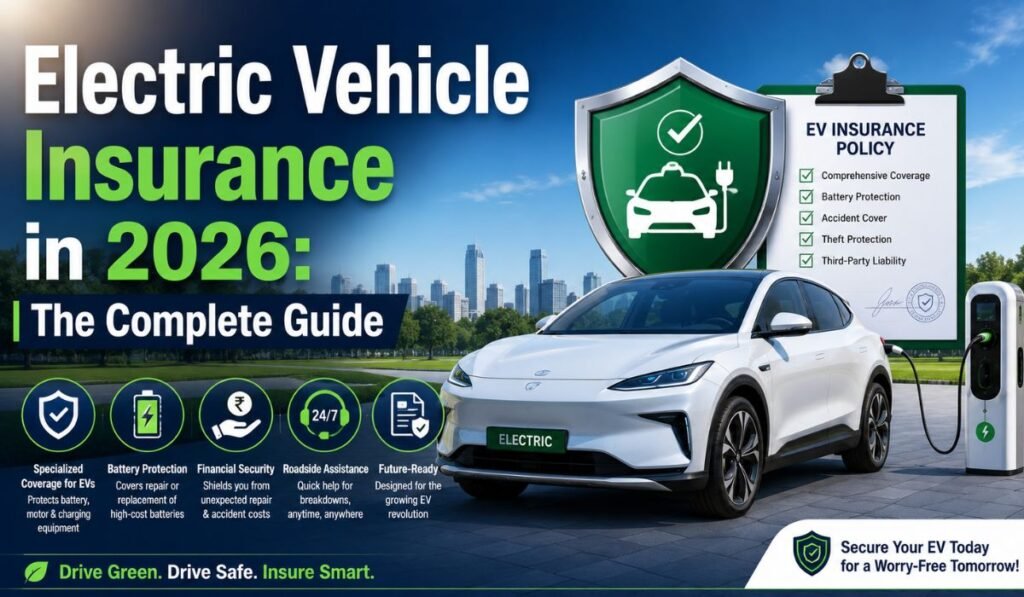
A historic change is underway in the Indian automotive landscape. In 2025, over 2 million electric vehicles were sold alone, and with government targets aiming for 30% EV penetration by the end of the decade, electric vehicle insurance is one of the fastest-growing segments within India’s insurance market. However many EV owners are either underinsured or unaware of how electric vehicle insurance is different from non-electric motor policies.
So read on to know your electric vehicle insurance options in 2026, which is not just smart if you own a two-wheeler EV, an electrical car or a commercial electrical vehicles. All you need to know stuff, this is a complete overview.
Why Electric Vehicle Insurance Is Different
Standard motor insurance is custom made for petrol and diesel engines. The risk profiles are simply different for electric vehicles than they are, however. The battery pack makes 40–60% of an EV purchase price. Replacing a defective battery in a Tata Nexon EV or MG Windsor EV can cost between ₹3 lakh to ₹8 lakh and this is an inherent risk that may not be fully covered by a standard policy.
It is for this reason that EV insurance policies in India have evolved to include dedicated add-ons like battery protection, roadside assistance in case of charge-related breakdowns and coverage for onboard charging equipment. In 2025–26, IRDAI (Insurance Regulatory and Development Authority of India) provided updated guidelines calling for the development of dedicated policy frameworks for EV with insurance.
Types of Electric Vehicle Insurance Available in India (2026)
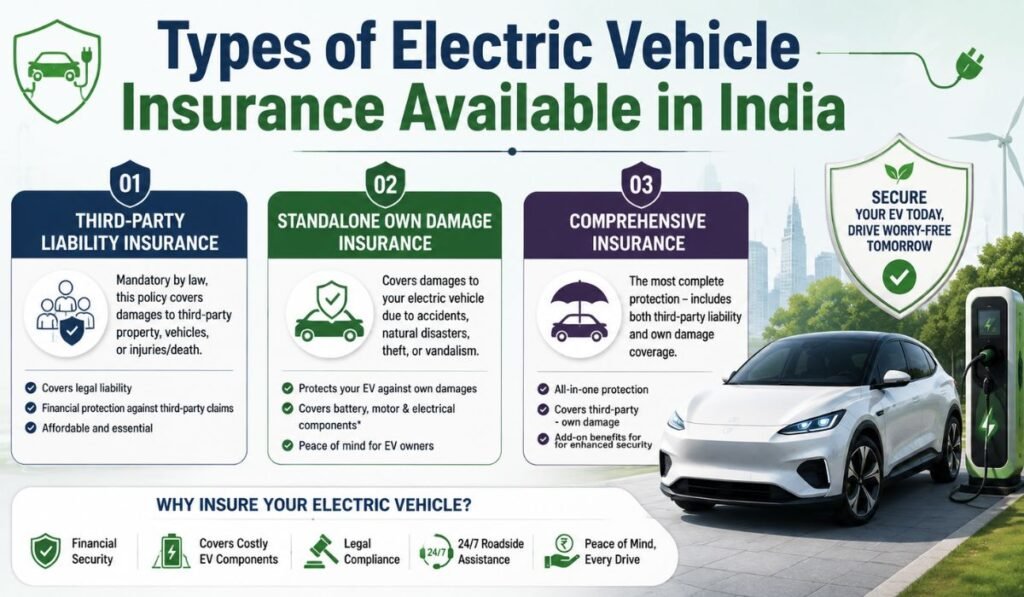
1. Third-Party Electric Vehicle Insurance (Mandatory)
Third-party insurance, the Motor Vehicles Act mandates for every vehicle in India which includes EVs too. It includes coverage for third-party liability, death or injury to another person and damage to someone else’s property caused by your EV. Premiums are regulated by IRDAI.
2. Comprehensive Electric Vehicle Insurance
You may already know that this is the best type of electric vehicle insurance for EV owners. It includes:
- Third-party liability coverage
- Comprehensive cover (against own damage, fire, theft and natural disasters)
- Battery damage cover (as add-on or built-in feature)
- Owner-driver personal accident coverage
3. Standalone Own Damage (OD) Policy
The Insurance Regulatory and Development Authority of India (IRDAI) introduced a unique option that allows EV owners to purchase own damage cover independently, adding it with third-party policy from another insurer.
Key Features to Look for in Electric Vehicle Insurance (2026)
| Feature | Description | Importance |
| Battery Cover | Covers cost of battery replacement/repair | Very High |
| Roadside Assistance (EV-specific) | Includes mobile charging/towing to charging station | High |
| Charging Equipment Cover | Covers home charger and portable charging kit | Medium |
| Zero Depreciation | No deduction for depreciation at claim time | High |
| Return to Invoice | Full IDV reimbursement on total loss | Medium |
| Personal Accident Cover | ₹15 lakh mandatory cover for owner-driver | Mandatory |
| NCB (No Claim Bonus) | Discount up to 50% for claim-free years | High |
Read Also:- United India Insurance | Max Life Insurance | Policy Bazaar
Electric Vehicle Insurance Premium Rates in India (2026)
IRDAI regulates third-party premium rates. For own damage, premiums are competitive and vary by insurer, IDV, and add-ons chosen.
Third-Party Premium Rates for Electric Two-Wheelers (2026)
| Motor Category | Engine/Battery Capacity | TP Premium (₹/year) |
| Electric Two-Wheeler | Up to 3 kW | ₹457 |
| Electric Two-Wheeler | 3 kW to 7 kW | ₹902 |
| Electric Two-Wheeler | Above 7 kW | ₹1,366 |
Third-Party Premium Rates for Electric Four-Wheelers (2026)
| Vehicle Category | Battery Capacity | TP Premium (₹/year) |
| Private Electric Car | Up to 30 kW | ₹1,780 |
| Private Electric Car | 30 kW to 65 kW | ₹2,904 |
| Private Electric Car | Above 65 kW | ₹6,712 |
IRDAI regulates third-party premium rates. Premiums are competitive for own damage and vary by insurer, chosen add-on and IDV.
Indicative Comprehensive Electric Vehicle Insurance Premiums (2026)
| Vehicle Model | Approx. IDV | Annual Comprehensive Premium (Est.) |
| Ola S1 Pro (Electric Scooter) | ₹1,10,000 | ₹3,500 – ₹5,500 |
| Tata Tiago EV | ₹8,50,000 | ₹18,000 – ₹25,000 |
| Tata Nexon EV | ₹14,00,000 | ₹28,000 – ₹38,000 |
| MG Windsor EV | ₹16,00,000 | ₹32,000 – ₹45,000 |
| Hyundai Ioniq 5 | ₹44,00,000 | ₹85,000 – ₹1,10,000 |
Disclaimer: As an added incentive to promote EVs in India, IRDAI offers a 15% discount on the third-party premium for electric vehicles.
Top Insurers Offering Electric Vehicle Insurance in India (2026)
The most competitive insurers now have dedicated insurance products for electric vehicles:
- Bajaj Allianz General Insurance is an EV-Specific Comprehensive Plan with inbuilt cover for the battery.
- HDFC ERGO – It provides paperless electric vehicle insurance and agent-free policy issuance
- Tata AIG – Competitive network for EV claims, particularly with Tata EV models
- Acko General Insurance – Digital-first insurer with attractive EV premiums.
- NEW INDIA ASSURANCE – PSU insurer with large garage network for EV repairs
- ICICI Lombard – Provides usage based electric vehicle insurance with telematics
Read Also:- PNB HRMS | New India Assurance | MEDISEP
Essential Add-Ons for Electric Vehicle Insurance in 2026
Since typical electric car insurance isn’t able to safeguard all EV-specific risks, picking the right add-ons is very significant. Most Important Riders are as follows:
1. Battery Protection Cover
Most important add-on for any EV Owner Not limited to just accidental damage, covers electrical and mechanical breakdown of the battery pack. In the absence of this, a claim can be rejected in case of battery failure.
2. Roadside Assistance – EV Specific
Conventional RSA covers mechanical breakdowns. EV-specific RSA also covers:
- Running out of charge mid-journey
- Tow to the nearest charging station
- Emergency mobile charging service
3. Zero Depreciation Cover
The depreciation curve of EVs and ICE cars differs significantly. It guarantees that you will receive the total repair/replacement cost without a write-down at claims time this is something we really recommend for new EV buyers to add.
4. Consumables Cover
The policy also covers consumables, including coolant and nuts and bolts, as well as EV-specific fluids not covered by standard policies.
5. Key Replacement Cover
Smart keys and digital fobs for EVs could be ₹15,000–₹40,000. This is the extension that can help you recover construction costs in case of loss or damage.
Factors That Affect Your Electric Vehicle Insurance Premium
Knowing what makes up your EV insurance premium better informs you in making decisions:
| Factor | Impact on Premium |
| IDV (Insured Declared Value) | Higher IDV = Higher Premium |
| Battery Capacity (kW) | Higher capacity = Higher TP Premium |
| Age of Vehicle | Older EVs have lower IDV and premium |
| Geographic Zone | Metro cities have higher premiums |
| No Claim Bonus (NCB) | Up to 50% discount on own damage premium |
| Add-ons Selected | Each add-on increases premium by 5–15% |
| Deductible Chosen | Higher voluntary deductible = Lower premium |
| Anti-theft Devices | ARAI-approved devices give discount |
How to File an Electric Vehicle Insurance Claim in India
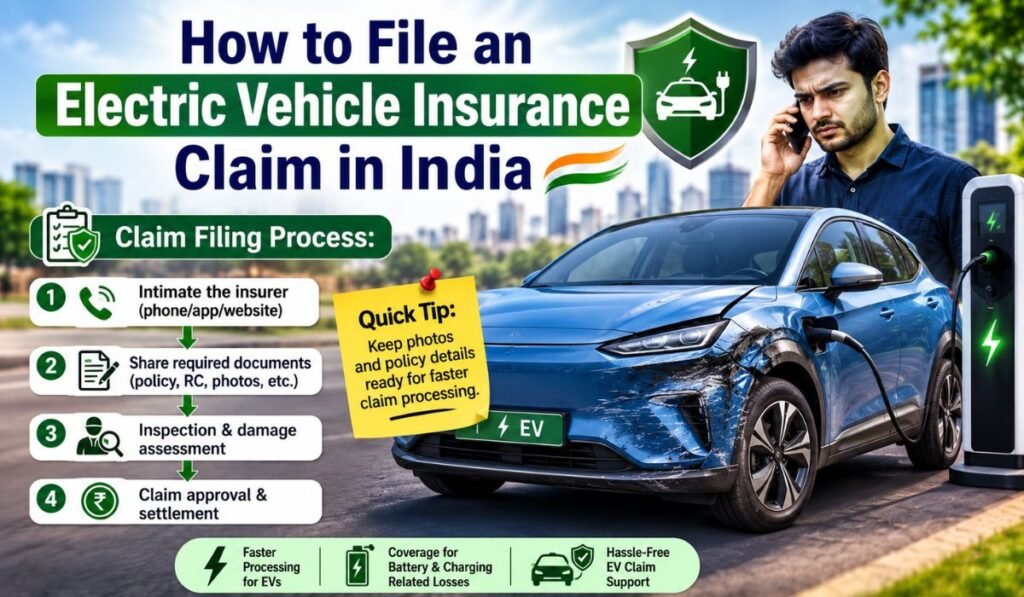
Most of the process to file an electric vehicle insurance claim in 2026 is a digital experience:
- Inform the insurer – post an app, website, or toll–free number for 24–48 hours after the event.
- Record the damage – Take clear pictures of the car, battery and surrounding area.
- FIR if needed – In cases of theft or involving a third-party, file an FIR at the nearest police station.
- Insurer survey – A surveyor (typically virtual/video-based for lower-value claims) assesses the damage.
- Garage/Service Centre approval – Cashless claims require an authorisation to a network of empanelled EV service centres.
- Battery Inspection – Some claims related to the battery may require an inspection done by a specialist EV technician.
- Claim settlement – As per policy terms cashless or reimbursement
Government Policies Supporting EV Insurance in India (2026)
To promote electric vehicle insurance, the IRDAI and Government of India have initiated various proactive measures to make this available at cost-effective rates:
- All EVs will have a 15% premium discount on TP as required by IRDAI
- The FAME III Scheme incentives support electric vehicle adoption indirectly, which increases the confidence of insurers
- Maharashtra MEGA states; Maharashtra, Delhi, Gujarat and Tamil Nadu all have insurance subsidy components as part of their state level EV polices
- Sandbox-type regulations to allow insurers to pilot usage-based EV insurance products
- Advocate for standardisation of battery specifications which makes risk assessment easier for insurers
Tips to Reduce Your Electric Vehicle Insurance Premium
- Have your car policy claim-free to benefit from No Claim Bonus (up to 50% discount)
- Fitment of ARAI-approved anti-theft devices for more discounts
- Check your bids online before renewing – premium rates have a wide national range across insurers.
- If you are a good driver, opt for higher voluntary excess
- Smartly bundle add-ons – include only those around usage patterns
- Telematics-based Insurance There are insurers who can also provide you with insurance based on the kilometres that you drive in a year.
Frequently Asked Questions on Electric Vehicle Insurance
Q1. Is electric vehicle insurance mandatory in India?
Yes. Similar to all other motor vehicles, third party electric vehicle insurance is a must under the Motor Vehicles Act, 1988 for any and every EV driving on Indian roads. You may be fined ₹2,000 and/or imprisoned for driving without it.
Q2. Does electric vehicle insurance cover battery damage?
Most standard all-perils insurance policies will not cover battery damage. This depends on the policy wording and whether or not you have bought a battery protection add-on. Always check your policy doc and choose battery cover explicitly – it is the most essential precaution for any EV owner.
Q3. Is electric vehicle insurance more expensive than regular car insurance?
Not necessarily. The lesser IDV is also because of battery costs but with IRDAI continuing to discount third party premiums by 15% this impact is mitigated to an extent. The premiums on comprehensive cover may be slightly more, but the level of protection is much wider and far more suitable for EVs.
Q4. What happens if my EV battery is damaged in a flood or natural disaster?
An electric vehicle insurance policy with a battery protection add-on covers damage due to natural calamities such as floods, cyclones and earthquakes. Because battery damage is not always covered, claiming damaged batteries without a suitable re-integrating battery add-on in place may be refused even if other vehicle damage is paid out for.
Q5. Can I transfer my existing car insurance NCB to an EV policy?
Yes. No Claim Bonus accumulated on a petrol/diesel car is transferable to your new electric vehicle insurance policy if you are swapping over from a petrol – diesel car to an EV. Collect your NCB certificate from where you obtained insurance in the past before buying your new EV policy.
Q6. Do home charging units get covered under electric vehicle insurance?
Alternatively, some insurance companies have the option for a home charging unit (wallbox charger) and portable charging cables cover under an add-on policy called “Charging Equipment Cover,” which protects you from accidental damage, fire or theft. It comes separately, not part of the regular electric vehicle insurance.
Conclusion
The Indian EV revolution is speeding up and electric vehicle insurance has a way to evolve. EV owners have more choices than ever, robust coverage frameworks, and regulatory support as 2026 approaches. But the secret to actually safeguarding your EV and your finances is making sure you know what you’re getting, selecting the right extras (read: battery protection) and shopping plans carefully before you buy or renew.
Electric vehicle insurance will no longer be a niche insurance product in India; it will the new normal of Indian motor protection as electric vehicles become mainstream across Indian cities and highways. Choose wisely today to protect your future EV ride tomorrow.
You can also explore the latest insurance updates and policy-related information at Corporate Insurance Policy.