Health security is among the top priorities for working families in India today, and one state has gone out on a limb to help. MEDISEP scheme has turned out to be the single most discussed programme in state due to several enhancements made in 2026. This scheme is intended for Kerala government employees and pensioners, their dependants (if applicable), and knowing how this works could help you save lakhs of rupees in case of a medical emergency.
The following is a comprehensive guide to the MEDISEP 2026 — coverage, premium, eligibility and benefits, hospital network & claims along with Phase II changes. This article will help you find out how MEDISEP has got your back and the back of your family before you go ahead and get covered.
What Is MEDISEP?
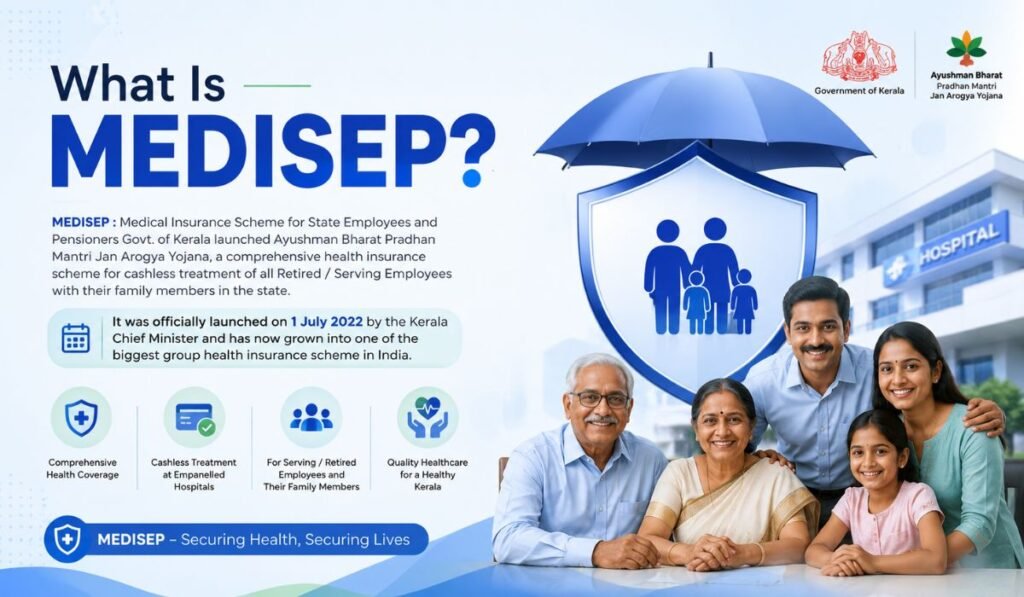
MEDISEP :Medical Insurance Scheme for State Employees and Pensioners Govt. of Kerala launched Ayushman Bharat Pradhan Mantri Jan Arogya Yojana, a comprehensive health insurance scheme for cashless treatment of all Retired / Serving Employees with their family members in the state. It was officially launched on 1 July 2022 by the Kerala Chief Minister and has now grown into one of the biggest group health insurance scheme in India.
Central to the concept behind MEDISEP is its simplicity: by pooling together the contributions of lakhs of employees and retirees, every member can access quality healthcare in empanelled hospitals without having to pay large out-of-pocket sums. The scheme ran for just 6 months with more than 29 lakh beneficiaries and dependants under the coverage of approximately 480 hospitals across majority of natural needs as per Kerala state.
This is not like a private health insurance policy that you purchase for yourself; this is a compulsory group scheme. The premium gets auto debited from your monthly salary or pension, hence remains covered without the worry of renewals lapsing. The Oriental Insurance Company, a public sector insurer manages the scheme by keeping the interest of the public as top priority for this programme.
Read Also:- United India Insurance
Who Is Eligible for the MEDISEP Scheme?

One major feature of MEDISEP is its very vast eligibility base. It is exciting so the scheme riders not only for employees but also their families and pensioners hence, it is a family-protection programme. The following groups are covered:
- All employees of the Kerala State Government in service
- Service pensioners and family pensioners
- Universities and local self-government institutions employees/pensioners
- The staff and their families of aided colleges and schools
- Part-time workers who are included under the government regulations
- Personal staff engaged directly by the Chief Minister, Ministers or Leader of the Opposition
- All India Service( AIS) officers, on optional basis
Spouses and children, as well as in most cases parents, are also considered your dependents within the same family unit. Because the scheme imposes no maximum age restriction on pensioners, it is effectively a form of health insurance for retirees from old age, an area where private insurers typically demand high premiums or refuse cover altogether.
MEDISEP Phase II: The Big 2026 Upgrade
Among other things, Phase II was introduced in which it would start functioning from 1 February 2026 and that is one of the most significant events in the recent history of MEDISEP. This second phase introduced broad improvements in coverage, treatment options and access to hospitals. These changes are likely to benefit a total of 31.8 lakh beneficiaries.
For a person, the headline upgrade is an increase in Base coverage ₹3 lakh to ₹5 lakh per family based on one year. In part, the wide variety of treatment packages available multiplied rapidly. While as per Phase I, almost 1,920 medical and surgical packages were given now approx2,516 under 41 specialty categories only for Phase II. Since the newly integrated MEDISEP treatment packages are derived from the Health Benefit Package 2022 approved by the national government, this standardises treatments across more hospitals.
A second welcome change is the limit of room rents. In Phase II, the room rent is covered245 per day for up to ₹5,000; pay wards in government hospitals are met246 even at₹2,000. Above these limits any excess rent must be paid by the beneficiary, but for most common treatments these limits are sufficiently generous as to avoid crippling out of pocket costs.
Also in phase II, major procedures are now covered at private hospitals. Phase I limited the coverage for these procedures to government hospitals while they are now extended to empanelled hospitals run by the private sector across all 14 districts. Two extremely expensive procedures, which were earlier exempted — Cardiac Resynchronisation Therapy with Defibrillator (₹6 lakh) and ICD Dual Chamber Implantation (₹5 lakh) — are included in this addon. About ₹40 crore is also allocated exclusively for critical ailments and organ donations.
Premium and Coverage: The 2026 Numbers
The basic question is how much the scheme costs, and what do beneficiaries get in return. Phase II brought with it a change in the premium structure, but still only about one-third to the fourth of any similar private family floater policy.
The premium amount is ₹500 per month in Phase 1. In Phase II, monthly premium increased to ₹687; meaning it imparts an annual premium of almost ₹8,224. While this number is lower than the ₹810 per month that was initially declared, service and employee groups had vocally opposed a higher median. You do not need to make any separate payment because the premium is deducted directly from salary or pension.
Below table summarises the key differences between Phase I and II so that you have a ready reference to see how the scheme evolved in 2026:
| Feature | Phase I | Phase II (2026) |
| Basic annual coverage | ₹3 lakh | ₹5 lakh |
| Monthly premium | ₹500 | ₹687 |
| Annual premium | ₹6,000 | ₹8,224 |
| Treatment packages | 1,920 | 2,516 |
| Specialty categories | — | 41 |
| Room rent limit | Lower | Up to ₹5,000/day |
| Pay ward (govt hospital) | — | Up to ₹2,000/day |
| Knee/hip replacement | Govt hospitals only | Private hospitals also |
| Emergency reimbursement (non-empanelled) | 3 treatments | 13 treatments |
| Policy term | 3 years | 2 years |
It says reducing the policy tenure from three years to two years will allow premium and package rates to be adjusted more regularly with rising medical inflation. The second phase was more of a pigeon-holed tender limiting the participation exclusively to public sector insurance companies that met the technical qualifications and so kept the programme within the public-sector boundaries.
Read Also:- Max Life Insurance
Key Benefits of the MEDISEP Scheme

The value of any health insurance programme is in the benefits and this is what makes MEDISEP quite distinct from any private option. These are the top benefits members can enjoy:
Day 1 coverage- of pre-existing diseases. With most private insurers, there is a waiting period of two to four years before they cover pre-existing conditions. This scheme provides coverage for pre-existing diseases on the very first day, which means there is no waiting period. This comes as a great relief to the many older employees and pensioners who have chronic illnesses.
No age limit for pensioners. Retirees and spouses remain covered regardless of age. This makes MEDISEP critical because private insurers usually refuse or load premiums for 60-year-olds, almost exclusively defending ages above this bar.
Cashless treatment at empanelled hospitals. Beneficiaries can simply walk into a network hospital, show their ID and avail treatment at the hospital without having to pay upfront for covered procedures. The insurance pays the hospital directly.
Emergency reimbursement at non-empanelled hospitals. This is especially true for cases where the coverage is typically limited to empanelled hospitals, and this scheme acknowledges that emergencies do not come with notice. Phase II — Here, 13 emergency treatments have been included (such as heart attack, stroke and road accidents, in addition to other 10 procedures added newly), where reimbursement is available even if the treatment was received at non-empanelled hospitals.
Coverage at specialist national institutes. In Phase II, there is a provision for reimbursing members receiving treatment from the Sree Chitra Tirunal Institute for Medical Sciences and Technology (SCTIMST) and the Jawaharlal Institute of Postgraduate Medical Education and Research (JIPMER), which provides access to high-quality specialist care.
Covers all members of the family in single premium. This premium covers the employee or pensioner plus entitled dependents, making it one of the cheapest family health insurance in India.
The Hospital Network
The success of a cashless scheme hinges on the number of good hospitals in its network. The way MEDISEP works is that it links up a large number of hospitals- the previous phase had around 480 empanelled hospitals, but the idea this time is to not embundle just few departments in one or two hospitals rather as many departments within each hospital.
In 2026, a key change over the previous iterations is that these agreements finalized with hospitals will now include provisions to empanel all possible departments in every facility. On the other hand, there is a common complaint from Phase I that an empanelled hospital does not have a particular department which might be necessary for the patient. The more recent Health Benefit Package 2022 packages are now available through many hospitals of both the public and private sector.
The government is using the services of Clinical Establishment Authority to control over-billing and exploitation in private hospitals and also added stricter contractual safeguards. If hospitals go against the contract, they are liable to strict action by the insurance company, which issues a standard operating procedure (SOP) to enforce adherence. This includes the addition of QR codes on cards for quicker access to beneficiary data.
Read Also:- Policy Bazaar: India’s Largest Insurance Marketplace
How to Check Your MEDISEP Status Online
Another good practice once you have been accepted as a beneficiary is to check the record and monitor your status every so often. It is easy to check your online status — You should follow these steps.
- Visit the official MEDISEP portal.
- Click the App Status option on the menu bar from the home page
- Your select category in the new window Employee or Pensioner.
- Fill in your Employee ID or Pensioner ID and Date of Birth.
- Type Search, and your current status will appear on the screen.
This quick check shows how you can ensure that your dependents are added correctly and how any changes (for example, in deductions automatically) are recorded as premium deduction entries. If he thanks you, you can raise any error through your drawing and disbursing officer or the grievance channels described below.
How to Use the Cashless Facility in 2026
At its core the cashless facility is such a scheme, and with the Phase II rollout, process has been significantly simplified. No more arranging for large lumps in case of emergency or paying a high room rent upfront. Now here is the method to use cashless facility
- Visit a network hospital. Then, visit any empanelled public or private hospital.
- Identify yourself. You can provide your registered Employee ID or Pensioner ID or display an updated 2026 ID card (used to be available for download from the portal).
- Get pre-authorisation. The insurance desk at the hospital will check your eligibility and apply for pre-authorisation from the insurer for your scheduled treatment.
- Receive treatment. If approved, payment for the relevant package entitles you to treatment without paying out of pocket for covered costs.
- Settle non-covered extras only. You are charged only for the items not covered under the package, say room rent over and above limit, or other consumables.
Non empanelled hospitals- 13 notified emergency treatments may require out of pocket payment followed by reimbursement, hence it’s prudent to preserve all bills/discharge summaries/medical records.
Claim Reimbursement Process
Reimbursement route — this is the route that applies in cases where cashless treatment cannot be availed of — such as, in emergencies when a patient is rushed to a hospital not on an empanelled list. The general steps are:
- Notify the insurer of the emergency admission at the earliest.
- Gather all original bills, prescriptions, diagnostic reports and the discharge summary.
- Complete the reimbursement claim form as provided by the insurer or available on your portal.
- Give the documents in the designated time.
- You can check the claim status online, and if there are any questions then you need to answer them quickly.
By mid-2025, more than 10.5 lakh claims aggregating ₹1,911 crore had been handled by MEDISEP which provides a sense of the scale at which the programme functions and how many medical bills go through it for beneficiaries.
Read Also:- What Is a Corporate Insurance Policy and Its Benefits ?
Comparison: MEDISEP vs Private Health Insurance
Comparing MEDISEP directly with a typical private family health insurance policy would help to understand the real meat of the product. The differences are striking:
| Parameter | MEDISEP (2026) | Typical Private Policy |
| Pre-existing diseases | Covered from day one | 2–4 year waiting period |
| Age limit | None for pensioners | Often capped or loaded after 60 |
| Premium payment | Auto-deducted from salary/pension | Paid separately every year |
| Premium cost | Low (group rate) | Higher, rises sharply with age |
| Renewal risk | Continuous coverage | Risk of lapse or non-renewal |
| Coverage amount | ₹5 lakh base + add-ons | Varies by plan and premium |
| Network | Empanelled public + private hospitals | Insurer-specific network |
That is why MEDISEP is seen as decidedly more pro-beneficiary than the government scheme — this comparison makes it clear. Very few private products can offer all three — cover for existing ailments from day one, no age limit and automatic premium deduction – at a similar cost.
Important Considerations and Concerns
No major plan comes without challenges and knowing about the same helps to make your use of the programme better. In April 2026, the government faced flak when it was revealed that health data of nearly 31.46 lakh beneficiaries — including employees, pensioners and dependents — had landed in the hands of private third-party administrators after a portion of operations were sublet. This resulted in many questions regarding data security, transparency and claims processing.
There have also been instances of claim rejections and disputes between beneficiaries and hospitals over billing. In case of a wrong denial or a dispute over what the claim should have been billed for, you can take the issue to the grievance redressal mechanism provided by the insurer and, if that doesn’t get resolved — eventually be able to approach the Insurance Ombudsman or consumer dispute platforms. Documenting each and every treatment in detail really does make you much safer in situations like these.
According to the mandatory guidelines, if husband and wife are both government employees, they will pay a premium separately because there is no upper limit on premiums for dependents provided it is capped collectively. Creating a plan that works within these guidelines is how families can avoid surprises.
Documents and Enrolment Essentials
As MEDISEP is a compulsory scheme, eligible employees and pensioners are automatically enrolled through the department and the premium deducted at source. Regardless, you must maintain your records clean as per the mapping of you and your dependents in the system. Another list of documents and information that generally carries significance include your Employee ID or Pensioner ID, Permanent Employee Number (PEN) when applicable, date of birth proof and correct dependent details in the form of name, date of birth, relationship etc.
Correction for missing or incorrectly input dependent should be raised through your Drawing and Disbursing Officer (DDO) or the respective pension-disbursing authority. Pensioners should pay extra attention to the names of their spouses as spousal coverage and family pension are dependent on this data being correct. One of the habits you can form is keeping a copy of your 2026 ID card (now with QR code to facilitate speedier checking) downloaded on your phone, since this will help speed up hospital admission in an emergency.
Any time you change departments, get a promotion, retire or have a marriage or birth in the family status — check your record to make sure it shows the change. A couple of minutes spent verifying this now can avoid problems with claims later, especially since the database of beneficiaries has crossed 31 lakh and multiple administrators are involved.
Read Also:- What is the Right Age to Purchase a Health Insurance Policy?
Practical Tips to Get the Most Out of MEDISEP
Understanding the rules is one thing and using them wisely is second. Here are some practical tips to help you get most out of the scheme and avoid pitfalls.
This can be done as follows-Firstly always check empanelment before a planned admission. Hospital empanelment and the particular departments covered may vary from policy years, so a quick call to the hospital insurance desk before the procedure saves you an unpleasant surprise. This verification is particularly relevant now that these non-urgent surgeries, like joint replacements, are permitted at private hospitals as part of Phase II.
Second, understand the package boundaries. All treatments correspond to a specific package amount and costs within these packages are all bundled in. Your expenditure includes room rents beyond ₹5,000 a day, upgrade of wards, or certain consumables. Requesting the hospital to provide a parameter for what is included in and not included in package helps us program finances beforehand and avoid disputes at discharge.
Third, maintain detailed documentation for any non-empanelled hospital emergencies. As, the 13 notified emergency treatments are entitled for reimbursement only on documentary evidence you should keep every original bill / prescription / diagnostic report and discharge summary. File your reimbursement claims as soon as you can, follow up online so it keeps moving.
Fourth, evoke the grievance mechanism when necessary. For both hospitals over-billing and a hospital refusing to provide a covered procedure or incorrectly rejecting a claim (nobody wins the quote-unquote contest of the careful word here), firm insistence through the insurer’s grievance mechanism is warranted. Documented complaints do matter as the government uses the Clinical Establishment Authority to stop exploitation. The Insurance Ombudsman and the consumer courts are alternatives if this does not help.
Lastly, consider the MEDISEP as a portion of your health-financial planning process rather than all. Though ₹5 lakh base cover and various packages provided along with are high, very high cost treatments / long hospital stay may still be beyond the limits. Other families decide that for their peace of mind, especially retirees with chronic conditions, they want a moderate personal savings cushion or a small top-up plan on their MEDISEP coverage.
The Bigger Picture: Kerala’s Healthcare Vision
MEDISEP is part of the larger Kerala ambition to provide universal healthcare by 2031. The state is creating a multi-layered safety net that directs quality care to those in need with programmes like the Karunya Health Security Scheme, which covers over 40 lakh families up to ₹5 lakh each. MEDISEP is an integral part of this larger structure: Farmers, consumers, private-sector employees and pensioners are other pillars but Phase II upgrades imply a long-term commitment to enhance it.
As the scheme progresses, members can look forward to regular updates to packages, premiums and the hospital network. By following the portal for any newest announcements and also checking your status regularly, you can take advantage of all the benefits which are available to yourself and family.
Frequently Asked Questions (FAQs)
1. What does MEDISEP stand for?
It is an abbreviation of Medical Insurance Scheme for State Employees and Pensioners, a health insurance scheme implemented by the Government of Kerala covering state employees, pensioners and their dependents.
2. What is the coverage amount in 2026?
While the Phase II saw a enhancement of the base annual limit from ₹3 lakh to ₹5 lakh per family, inclusion of extra packages and isolated corpus to cover illnesses requiring extreme enemy of malignant growth medications and organ transplants.
3. How much premium do I pay?
The monthly premium for Phase II is ₹687, which works out to ~₹8,224 annually. It gets automatically deducted from your salary or pension.
4. Are pre-existing diseases covered?
Yes. The coverage is from day 1, meaning pre-existing diseases are covered immediately without a waiting period which was the most unique thing about the scheme.
5. Is there an age limit for pensioners?
No. The scheme especially beneficial for the elderly has no upper age limit.
6. How many hospitals are in the network?
There were approximately 480 empanelled hospitals when the network started and it continues to expand, with Phase II contracts meant to empanel additional departments within each hospital.
7. Can I get treatment at a non-empanelled hospital?
In fact, even if such patients move to a non-empanelled hospital for 13 notified emergency treatments — ranging from heart attack and stroke to road accidents — they are still eligible for reimbursement.
8. How do I check my status online?
Go to official portal, Click on Status option, Select Employee or Pensioner, type in your id and DOB ans click search.
9. How long is the policy term in Phase II?
Compared to the three years policy term in Phase I, the maximum period of time in Phase II is limited to two years, which lowers the restriction on frequency of adjusting premium and package rates.
10. Who implements the scheme?
It is executed through The Oriental Insurance Company – a public sector insurer, supported by third-party administrators.
Conclusion
The Kerala government employees and pensioners, MEDISEP is a solid financial shield from the expensive health care services than a regular deduction from their salary. The new scheme is certainly much more potent than the original one, with ₹5 lakh coverage for a family, covered treatment packages extended to over 2,500 procedures, larger access targets for private hospitals and more powerful emergency provisions coming in with the Phase II upgrades rolled out in 2023.
Data handling and disputes over claims are ongoing challenges, but on balance the value proposition is a no brainer: immediate coverage from day 1 with respect to pre-existing conditions, unrestrictive age limits for retirees, low automatic premiums deducted directly from one paycheck or pension that cannot be easily matched by any private product. Find out if you are eligible, have all your documents ready and keep checking for updates on your status to make sure that MEDISEP delivers on its promise of reliable and cashless healthcare benefits assured for you and your family till 2026 or beyond.