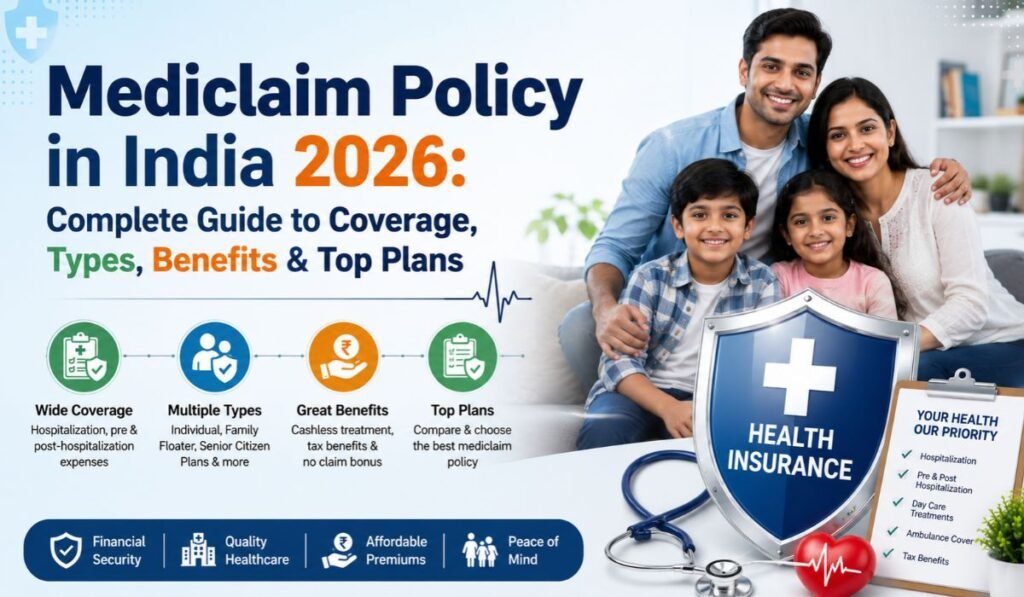
Even as India is facing a Medical inflation of about 15% on the rise, it becomes imperative for everyone to get prepared to manage medically catastrophic events arising out of health emergencies. The mediclaim policy is one of the most intelligent tools to save yourself and your family from the huge hospitalisation expense. Types of Mediclaim, Coverage, Premiums and Tax Benefits offered. Whether you are purchasing a mediclaim policy for the first time or renewing existing one: this guide is just what you need to know in 2026 along with advice on the best plans available today
What Is a Mediclaim Policy?
A mediclaim policy is a health insurance product that covers medical expenses for any illness, injury, or accident. Medical Insurance Keeping in mind that mediclaim policy refers to the provision of reimbursement of medical cost (medical treatment arising due to illness, injury or accident). In the case of a mediclaim policy, an insured receives reimbursement for hospitalisation bills or has them settled directly with network hospitals through a cashless facility.
A mediclaim policy is not the same as a critical illness plan, which provides a single payment on diagnosis; unlike the latter, it pays for specific treatment costs room rent, surgery fee, doctor consultation fees, diagnostics tests and post-hospitalisation expenses. Before a medical emergency occurs, every earning individual and family in India should definitely work on having valid mediclaim policy.
Types of Mediclaim Policy in India (2026)
The first step is knowing the type of mediclaim policy you need.
| Type | Who It Covers | Key Feature |
| Individual Mediclaim Policy | Single person | Dedicated sum insured per person |
| Family Floater Mediclaim Policy | Entire family | Shared sum insured, lower premium |
| Senior Citizen Mediclaim Policy | Persons 60+ | Higher premiums, covers age-related illnesses |
| Group Mediclaim Policy | Employees/members | Employer or group-sponsored, lower cost |
| Critical Illness Rider | Individual/family | Add-on cover for specific serious diseases |
| Top-Up Mediclaim Policy | Individual/family | Extra coverage above a deductible threshold |
The major benefit of choosing a family floater mediclaim policy is that premiums are much lower than individual policies since the sum insured can be used by multiple members up to the limit. This is one of the most popular variants of the mediclaim policy sold in India today, making family floater a very sought after buy.
Read Also:- United India Insurance | Max Life Insurance | Policy Bazaar
What Does a Mediclaim Policy Cover?
Contents of a regular mediclaim policy in 2026 normally consist of:
- Quantity room price, nursing charges, surgeon fees, anesthesia, and OT Costs for in-patient hospitalization receiving more than 24 hours
- Pre-hospitalisation charges: The expenses incurred in 30 days prior to hospitalisation are covered under the mediclaim policy.
- Post-hospitalisation costs – Costs incurred 60–90 days after hospitalisation are also covered.
- An examination of day care procedures: Procedures using modern technology which take less than a day
- Cashless take care: The mediclaim strategy offers the scheme of getting cashless treatment in network medical clinics where insurance agency pays for their clinical costs with the doctor.
- AYUSH treatments: Ayurveda, Yoga and Naturopathy, Unani, Siddha and Homeopathy systems benefits are offered upto 100% of sum insured in the top plans
- Ambulance fees: Limit per claim
- Organ transplant: generally covered by most comprehensive plans
- Advances in treatments – Robotic surgeries, oral chemotherapy therapy, intravitreal injections and even balloon sinuplasty are more widely covered
What a Mediclaim Policy Does NOT Cover
No mediclaim policy covers everything. Key exclusions include:
- Oral and dental treatment (unless caused by an accident)
- Self-inflicted injuries
- War and nuclear hazards
- Maternity (unless covered with an add-on or a specific plan)
- Substance abuse-related treatments
- Treatments outside elected AYUSH defined limits on the ground of nonallopathic
- Surgeries or procedures for cosmetic or dental purposes are excluded under standard mediclaim policy terms
Waiting Periods Under a Mediclaim Policy
Waiting period is the time you have to wait before your mediclaim policy helps you benefit.
| Waiting Period Type | Duration |
| Initial waiting period (general illnesses) | 30 days |
| Pre-existing diseases (PED) | 2–4 years (typically 3 years) |
| Specific illnesses (e.g., cataract, joint replacement) | 1–2 years |
| Maternity benefit waiting period | 2–4 years |
| Congenital conditions | 3 years continuous coverage |
Under IRDAI’s 2024 regulations, insurers were not allowed to refuse coverage solely on the ground of pre-existing conditions. As a result, these conditions are covered under the policy after the waiting period of up to 3 years. This is a huge benefit to the consumer as during porting of your mediclaim policy from one insurer to another, the waiting period already served is carried forward.
Top Mediclaim Policy Plans in India 2026
| Plan Name | Sum Insured Options | Key Benefit | Ideal For |
| New India Mediclaim Policy | ₹1L – ₹15L | Cumulative bonus 25% per year, max 50% | Individuals & families |
| Niva Bupa ReAssure 3.0 | Unlimited | Unlimited sum insured restoration | High-risk individuals |
| Star Health Family Health Optima | ₹3L – ₹25L | Auto recharge of sum insured | Families |
| HDFC Ergo Optima Secure | ₹5L – ₹2Cr | 2x base sum insured from day 1 | Middle to upper income |
| ICICI Lombard Complete Health | ₹3L – ₹50L | Wellness benefits & OPD cover | Working professionals |
| National Mediclaim Plus (Plan A/B/C) | ₹1L – ₹15L | Adventure sports cover, OPD optional | Young adults |
The Niva Bupa ReAssure 3.0 plan offers a key advantage by allowing the policyholder to select an unlimited sum insured, thanks to its ReAssure Forever feature which reinstates the sum insured an unlimited number of times over the lifetime of the policy after payment of the first claim has been made. This is the staunch competitor when it comes to finding a suitable mediclaim policy for families.
Read Also:- PNB HRMS | New India Assurance | MEDISEP
Mediclaim Policy Premium: What to Expect in 2026
The premium for a mediclaim policy varies according to factors such as age, location (zone), sum insured and number of members covered.
| Coverage | Approximate Annual Premium (2026) |
| Individual (Age 30, ₹5L cover) | ₹6,000 – ₹10,000 |
| Individual (Age 45, ₹5L cover) | ₹12,000 – ₹20,000 |
| Family Floater (2 adults + 2 kids, ₹10L) | ₹12,000 – ₹35,000 |
| Senior Citizen (Age 65, ₹5L cover) | ₹30,000 – ₹55,000 |
As illustrated all previous examples, the premium of a mediclaim policy for family is generally between ₹12,000 and ₹35,000 for ₹10-lakh floater (depending on age of the oldest member and inclusion of No Claim Bonus).
The policyholder would be offer a third option, of paying a voluntary co-pay of 20%, which will fetch them a 15% reduction in premium payable – this can come handy if you reduce your mediclaim policy cost without reducing sum insured.
No Claim Bonus (NCB) – A Reward for Staying Healthy
One big advantage with holding a mediclaim policy and not claiming is, No Claim Bonus (NCB).
Every year without a claim the cover gets increased by 50% and at no extra premium, which means a ₹10-lakh coverage increases to ₹15 lakhs after five years without any added fare. For example, New India has a mediclaim policy that provides cumulative bonus at the rate 25% of sum insured for every claim-free year, subject to maximum of 50% of bounty sum insured.
Tax Benefits Under a Mediclaim Policy
Apart from safeguarding you against health-related costs, premiums towards a mediclaim policy are eligible for income tax deductions also making it financial prudent too.
To claim a deduction on premiums paid for your own self, spouse and children or senior citizen parents (deduction of up to ₹25,000), please take advantage of section 126 (formerly known as section 80D) under the Income Tax Act, 2025.
| Who Is Covered | Maximum Deduction |
| Self, spouse & children | ₹25,000 per year |
| Senior citizen parents | ₹50,000 per year |
| Self + Senior citizen parents | ₹75,000 per year |
This is an additional benefit in value of holding an active mediclaim policy each financial year.
How to Choose the Right Mediclaim Policy
How to Choose the Right Mediclaim Policy in 2026 – To Select The Fare Mediclaim policy several factors:
- Adequate sum insured: With medical inflation pegged at 15%, urban families should opt for minimum ₹10 lakhs
- Network of hospitals: Check the cashless hospital network of the insurer in your city
- Claim settlement ratio: Look for insurers with a higher than 95% ratio
- More POV you have better for Start Period to PED
- Room rent sub-limits: Avoid plans that limit room rent on a percentage basis – it places limits on the overall clause eligibility.
- Create steps to safeguard families from risks with restoration benefit – Plans which give full restoration of sum insured after a claim
- Renewability: Check whether the insurer actually permits renewal post 80 years without huge increases – this is particularly important for long-term mediclaim policy holders
In general, public sector insurers provide a lower premium outgo and a more stringent claim settlement process, while private insurers such HDFC Ergo, ICICI Lombard and Star Health tend to offer faster cashless settlement at an almost 10–15% higher premium.
How to Port Your Mediclaim Policy
You can port your mediclaim policy only at the time of renew, after underwriting. Usually, one can apply for it 30 to 60 days before renewal and waiting period credit already served is carried forward but if you increase Sum Assured, fresh waiting periods may apply for the incremental amount.
Portability requests are now also subject to strict timelines, simplifying the process of transferring policies from one insurer to another and allowing policyholders greater flexibility while switching over to a superior plan.
Frequently Asked Questions on Mediclaim Policy
Q1. Is a mediclaim policy the same as health insurance?
Yes, in broad terms a mediclaim policy and health insurance are often used synonymously in India. On the other hand, a mediclaim policy only covers expenses that relate to hospitalisation and some products in health insurance provide OPD and wellness-based benefits or critical illness lump-sum payout. Mediclaim is actually the sub-set of Health insurance,which is primarily for hospitalisation.
Q2. Can I have two mediclaim policies at the same time?
Yes. While, IRDAI has made provisions allowing for the use of multiple health policies pertaining to a single hospitalisation. In real world, you typically exhaust one insurer first (usually cashless), and only claim the out of pocket amount from the second insurer as reimbursement, accompanied by summary of claim settlement from first insurer. If the employer-provided group cover is inadequate, then having two mediclaim policy covers can come in handy.
Q3. What happens to my mediclaim policy if I change jobs?
Your employer group mediclaim covers you only as long as you are with an organisation. Either port it to an individual plan or take a personal mediclaim policy usually at once, so as not to have any further coverage gap. In fact, portability from group to individual plans is permitted under IRDAI guidelines in several instances.
Q4. Does a mediclaim policy cover pre-existing diseases?
According to the regulations released by the IRDAI in 2024, insurers cannot refuse coverage on pre-existing diseases. However, there is a waiting period of close to 3 years until those illnesses are eligible for coverage under the policy. When purchasing your mediclaim policy, it is mandatory and legally necessary to disclose all pre-existing diseases.
Q5. What is the ideal sum insured for a mediclaim policy in 2026?
Health insurance policies with a sum insured of less than ₹3 lakhs are now considered inadequate in view of medical inflation being 15% + per annum.However, financial experts recommend any amount as the minimum sum assured should not be less than ₹10 lakhs for residents of metro cities and ₹5 lakh’s for those living in tier-2 cities. In a family floater, families must go for a mediclaim policy of ₹15–20 lakhs at least to be reasonably covered against serious diseases or surgeries
Q6. Can a senior citizen buy a mediclaim policy?
Yes. Almost all of the insurers have specialized senior citizen mediclaim policy plans available for individuals 60 years or older. Cover is available but at an increased premium price given the risks associated with age. The entry age ranges between 65–80 years depending on the insurer and lifetime renewability is an added feature in all decent senior citizen mediclaim policy products in 2026.
Conclusion
A mediclaim policy is no longer an luxury but a financial imperative, with the changing landscape of healthcare in india. A good mediclaim policy is like a cushion for your family in these days of high hospital bills, the increasing incidence of lifestyle diseases at an early age and soaring medical inflation. In whichever category, whether individual or family floater mediclaim or senior citizen plan, early purchase, full and frank disclosure and frequent cover review is the way to go. Check claim settlement ratio, network hospitals and room rent caps before you decide on the mediclaim policy – a good decision now can help your family avoid a financial embarrassment later.