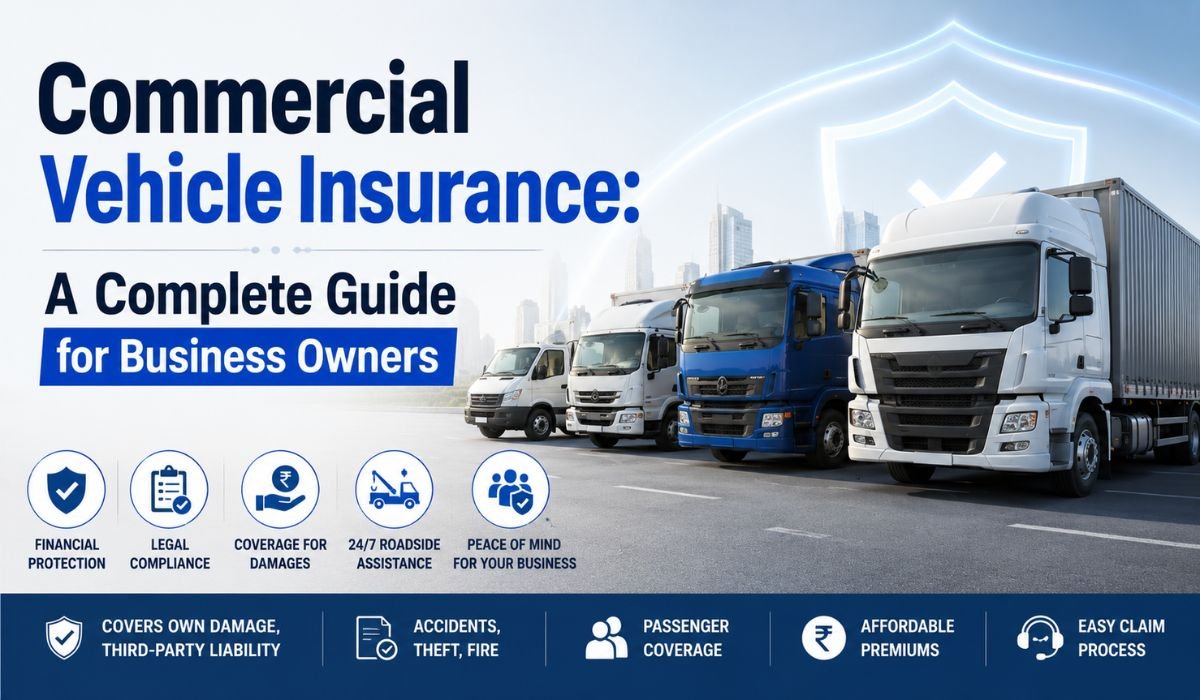
Operating a vehicle-dependent business from a single delivery van to an entire fleet of trucks exposes you to financial perils that standard car insurance — does not provide protection against. This is where Commercial Vehicle Insurance comes in. Commercial Vehicle Insurance is a type of specialized insurance policy that covers vehicles used for business or commercial use rather than personal use. In this article, we have covered everything related to Commercial Vehicle Insurance, its various types, advantages, coverage and exclusions, factors impacting premium and tips for selecting the best policy for your vehicle.
What is Commercial Vehicle Insurance?
Commercial Vehicle Insurance is an insurance policy that provides coverage for vehicles used in the course of business including the transportation of goods, passengers or delivering services. Commercial Vehicle Insurance is not the same as Private Car Insurance because of the additional higher risk associated with commercial use longer hours on the road, heavier loads, multiple drivers and increased exposure to accidents.
This insurance is compulsory under the Motor Vehicles Act for any vehicle that is being used as commercial. If it is a taxi or truck, bus, delivery van, etc. which is owned by you and used for business, it becomes legally mandatory as well as wise to enforce a Commercial Vehicle Insurance coverage.
Why is Commercial Vehicle Insurance Important?
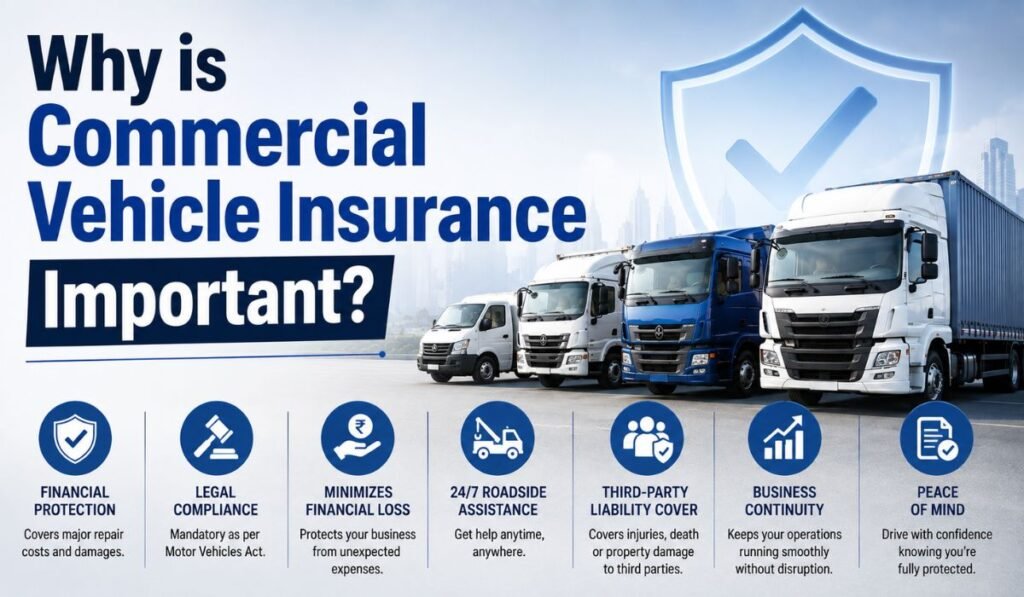
Due to being on the road far more than personal vehicles, commercial vehicles have an even greater risk of being in accidents or having theft and damage. Even a single accident could bankrupt a business without insurance, costing thousands of dollars in repair bills, medical payments and lost income due to vehicle downtime or legal liabilities.
Commercial vehicles are usually driven electronically by a specific organization.
- Verifying Legal Compliance Costs – It is unlawful to drive on public roads in a business vehicle without legitimate insurance coverage.
- Financial Protection – It protects the owners of the business from losing huge amounts of money due to accidents, burglary, or natural calamity.
- Third Party Liability Coverage – This type of coverage provides cover against damages or injuries caused to third parties.
- Business Continuity – This will prevent a single incident from wiping out your business financially.
- Driver and Passenger Safety – Most policies cover drivers and passengers too.
Types of Commercial Vehicles Covered
Commercial Vehicle Insurance, like all insurance products, is not one size fits all. It is wise to have different coverage according to the usage of each vehicle. The common categories are summarized in the table below.
| Vehicle Category | Examples | Typical Usage |
| Goods Carrying Vehicles | Trucks, tempos, mini-trucks | Transporting goods and materials |
| Passenger Carrying Vehicles | Buses, taxis, cabs, autos | Transporting passengers commercially |
| Special Purpose Vehicles | Cranes, tractors, construction vehicles | Used at construction or industrial sites |
| Delivery Vehicles | Delivery vans, three-wheelers | E-commerce and courier delivery services |
| Miscellaneous Commercial Vehicles | Ambulances, tankers | Specialized commercial operations |
Types of Commercial Vehicle Insurance Policies
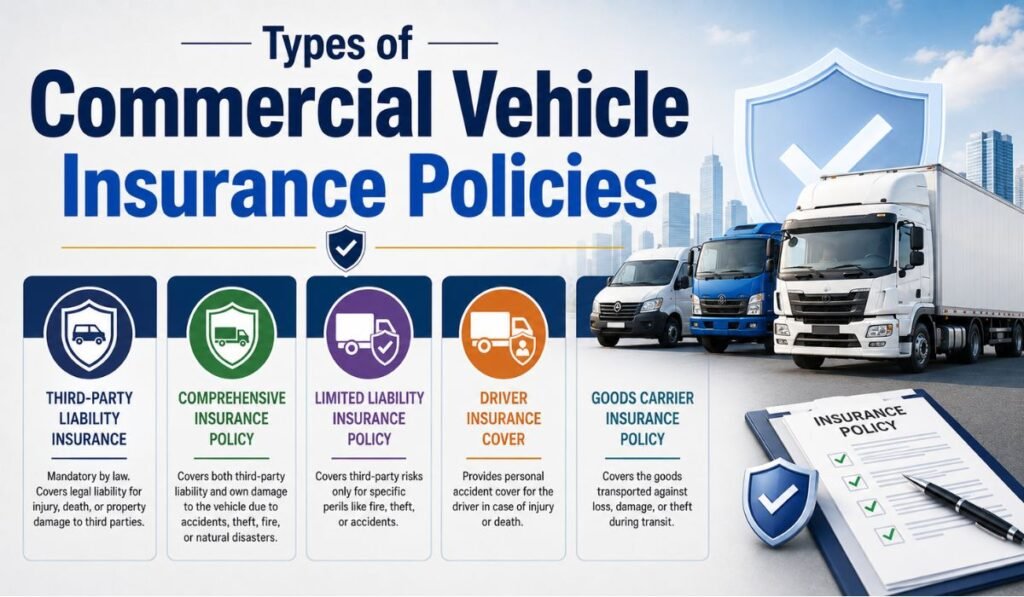
Commercial Vehicle Insurance: There are usually three classes of Commercial Vehicle Insurance policies on the market. By distinguishing between the two, business owners can determine how much protection they require.
1. Third-Party Liability Insurance
It is a basic and legally required trading vehicle insurance. It specifies the damages or injuries caused to some third party (person or property) as a result of an accident concerning your commercial vehicle. It does not include damage to your own vehicle.
2. Comprehensive Commercial Vehicle Insurance
This policy covers a much broader area: in addition to third-party liabilities, it also protects any damage that your car might have after an accident or fire or theft as well as any natural disasters (flood, etc) and vandalism. And it is the most popular option chosen by business owners as it provides full coverage.
3. Standalone Own-Damage Cover
A Type of Policy That Covers Damage to Your Own Commercial Vehicle but Not Third-Party Liability. Usually, this is purchased with a separate third-party liability policy.
What Does Commercial Vehicle Insurance Cover?
A comprehensive Commercial Vehicle Insurance comes with the below coverages-
- Damage from collisions or accidents
- Fire, explosion, or self-ignition damage
- Theft of the vehicle
- Natural Calamities – Floods, Earthquake, Storms or Landslides Damage
- Being damaged in transit by rail and road transport, air or water routes;
- Fifth-lying in insanity.
- Benefits of Cover For the Owner-Driver
- It does not cover damages caused by riots, strikes or vandalism.
What is Not Covered Under Commercial Vehicle Insurance?
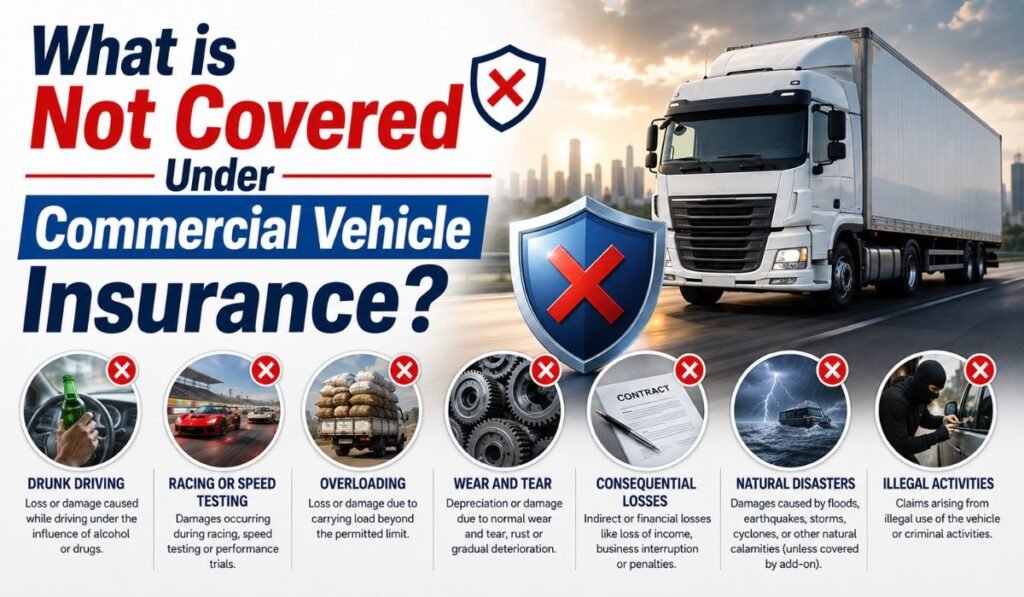
Commercial Vehicle Insurance is a vast coverage but there are certain exclusions that one should be aware of when being a policyholder:
| Exclusion | Description |
| Normal Wear and Tear | Gradual depreciation of vehicle parts is not covered |
| Driving Without a Valid License | Claims are rejected if the driver lacks a valid license |
| Driving Under Influence | Accidents caused due to alcohol or drug influence are excluded |
| Mechanical or Electrical Breakdown | Damage due to internal mechanical failure is not covered |
| Consequential Loss | Indirect losses like loss of business income are excluded |
| Using Vehicle for Unauthorized Purpose | Using a goods vehicle to carry passengers, or vice versa |
| War and Nuclear Risks | Damage caused by war, invasion, or nuclear risks is excluded |
Factors Affecting Commercial Vehicle Insurance Premium
Premium of Commercial Vehicle Insurance is not Fixed and Based on Multiple Factors. Based on the risk profile associated with the vehicle and its usage, insurance companies calculate the premium. In the below table these are key factors in brief.
| Factor | Impact on Premium |
| Type of Vehicle | Heavier vehicles like trucks generally have higher premiums |
| Cubic Capacity/Tonnage | Higher load capacity increases premium |
| Age of the Vehicle | Older vehicles may have lower Insured Declared Value, reducing premium |
| Geographic Zone of Registration | Vehicles registered in high-risk zones attract higher premiums |
| Add-on Covers Selected | Additional covers increase the overall premium |
| No Claim Bonus (NCB) | A claim-free history reduces the premium |
| Type of Policy Chosen | Comprehensive policies cost more than third-party-only policies |
| Number of Drivers/Usage Intensity | Vehicles used more frequently attract higher premiums |
Add-On Covers Available with Commercial Vehicle Insurance
As personal vehicle insurance, business owners can add additional functionalities to a Commercial Vehicle Insurance policy for added protection:
- Zero Depreciation Cover – This allows you to get your claim amount in full without any deduction for the cost of replacement parts, which may sometimes depreciate.
- Engin Protection Cover – Covers damage to your engine from water ingression or oil leakage
- Roadside Assistance – emergency assistance, whether it be breakdown Help.
- With Return to Invoice Cover – Covers the insured for the invoice value in case of total loss or theft.
- Consumables Cover – Covers the expense of consumables like engine oil, nuts, bolts etc during repair.
- Passenger Cover – Indemnifies against the injury or death of passengers in an event of an accident.
How to Choose the Right Commercial Vehicle Insurance Policy
Choosing a proper Commercial Vehicle Insurance policy involves careful evaluation of your business needs. Here are some practical tips:
- Evaluate Your Vehicle Use – Determine if you use your vehicle to transport property, passengers or for other special needs.
- Comparison of Multiple Insurers–Different companies offer different premiums and benefits, thus comparison is required.
- Verify Claim Settlement Ratio – Higher the claim settlement ratio, greater is the reliability of an insurer.
- Assess Add-On Features – Look for add-ons tied to the actual risks of your business.
- Carefully Understand the Policy Wordings – Before buying, read exclusions and terms
- Look for the Insured Declared Value (IDV) – The IDV should be such that it is commensurate with your vehicle’s true market value.
- Cashless Garage Network – Have a wide cashless garages network for hassle-free claim settlement.
How to File a Claim Under Commercial Vehicle Insurance
In the event of an accident or damage to your commercial vehicle, here is how you go about claiming.
- Notify the Insurer Immediately – Notify your insurance provider as soon as possible.
- Lodge an FIR if Required – In the case of theft, a major accident or injury to a third party it is important to report incident at police station.
- Photograph – Click pictures of the damaged areas for record.
- Have the car examined – A surveyor designated by the insurance agency will examine the harm.
- Upload Documents – Upload your policy copy, RC, driving license and FIR (if applicable).
- Repair and Settlement – You can go for cashless repair or reimbursement, depending on the nature of the claim.
Commercial Vehicle Insurance vs Personal Vehicle Insurance
Most individuals get confused with Commercial Vehicle Insurance and personal vehicle insurance, but both are very different. The differences are shown in the table below.
| Parameter | Commercial Vehicle Insurance | Personal Vehicle Insurance |
| Purpose of Use | Business or commercial activities | Personal or family use |
| Premium Cost | Generally higher | Generally lower |
| Risk Level | Higher due to frequent usage | Lower due to limited usage |
| Legal Requirement | Mandatory for commercial vehicles | Mandatory for private vehicles |
| Coverage Scope | Includes goods, passengers, third-party liability | Mainly covers own vehicle and third-party liability |
Benefits of Having Commercial Vehicle Insurance
When it comes to ensuring your company vehicle you should consider investing in a good Commercial Vehicle Insurance policy, here are some of the long term advantages:
- Shield your business from unforeseen financial liabilities
- Ensures compliance with legal requirements
- Establishes trust with customers and partners that depend on your transportation services
- Lowers downtime as cashless garages approve rapid repairs
- Peace of mind during driving vehicles on the fast roads
- Covers drivers and passengers, indicates concern for employee welfare
Common Mistakes to Avoid When Buying Commercial Vehicle Insurance
- Derating the Vehicle – Opting for a low IDV to save on premium, may leave you short changed at claim time.
- Overlooking Add-On Covers – Adding useful covers to your base policy may leave you with insurance gaps.
- Non-Renewal at the Right Time – If policy is lapsed, then one might have to face legal penalty and lose No Claim Bonus.
- Giving Wrong Information – Using the vehicle in a wrong way can cause your claim to be rejected.
- Staying with the first insurer – The life of a content business owner means avoiding wasting time comparing quotes and settling for whatever lands in your inbox, usually at a minimum cost but not always the optimal result.
Conclusion
Commercial Vehicle Insurance is more than just a legal requirement – it is an essential protection for any business that uses vehicles to conduct its work. Everything from safeguarding from accident, theft to third-party liable insurance an ideal Commercial Vehicle Insurance policy allows your business to run well. With an understanding of the coverages, exclusions, and factors affecting premiums for business owners insurance leads to informed policy selections to best suits needs. Make sure you compare several insurers, check for extra add-on covers, and read the policy terms thoroughly before getting Commercial Vehicle Insurance for your fleet or vehicle!
FAQs
1. Is Commercial Vehicle Insurance mandatory by law?
Yes, it is a legal requirement that any vehicle used for business/commercial use has to be covered with at least third-party Commercial Vehicle Insurance.
2. What is the difference between comprehensive and third-party Commercial Vehicle Insurance?
Third-party insurance will only pay for any damage done to a third party, while comprehensive Commercial Vehicle Insurance offers protection against third-party liabilities and compensates for damages caused to your own vehicle as well.
3. Can I transfer my No Claim Bonus while switching insurers for Commercial Vehicle Insurance?
Yes, based on your claim-free record, you can transfer the No Claim Bonus received from your previous Commercial Vehicle Insurance policy to a new insurer when you upgrade.
4. Does Commercial Vehicle Insurance cover the driver’s injuries?
Most Commercial Vehicle Insurance policies offer a cover for personal accident cover for the owner-driver with additional coverage available for passengers.
5. How is the premium for Commercial Vehicle Insurance calculated?
The premium varies according to factors like the type of vehicle, total tonnage, age of the vehicle, geographic zone where the MOCR is located, previous claim history and policy or add-ons chosen.
6. What happens if my Commercial Vehicle Insurance policy lapses?
If your policy is not renewed, you are not allowed to drive the vehicle on public roads, as this voids your Commercial Vehicle Insurance cover and deems you unable to apply for a No Claim Bonus in future.