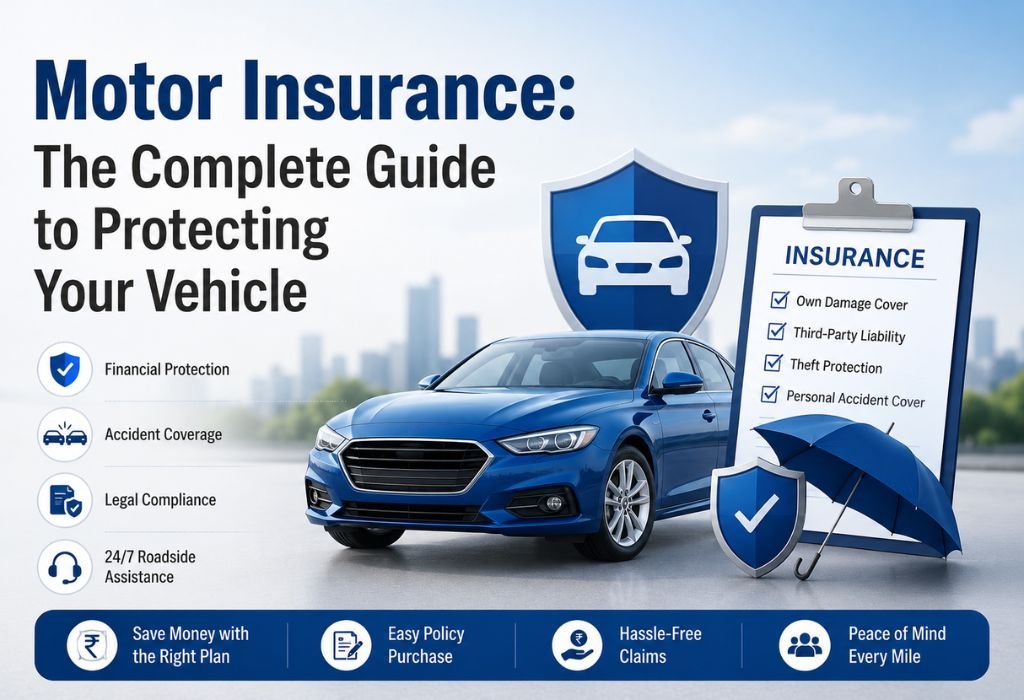
Motor Insurance: Having a vehicle is a dream for many but comes with the responsibility. If you use two-wheeler for manoeuvring through congested city roads or a family car for capturing weekend adventures, your vehicle is generally part of most individuals top financial transactions ever. However, protecting that investment — and yourself from unforeseen liabilities is where Motor Insurance comes into play. This guide outlines the essentials and advanced concepts of vehicle protection wherever it be, whatever model or make and helps you to make informed decisions that are shaped around your needs.
With ever-higher vehicle costs, costly replacement parts and a battlefield of uncertain road conditions on which to operate your vehicle; one accident or theft can trigger an insurance event that has serious financial consequences. What lies between you and that risk when it suddenly hits is a well-chosen policy, which transforms what could be a cataclysmic loss into one that can be managed. Let us only get deeper into the topic so you can drive without second-guessing yourself.
What Is Motor Insurance?
Motor Insurance, is a contract between an automobile owner and an insurance company to provide financial protection against theft, accidents, natural calamities, and third-party liabilities. What they do is through payment of a premium, the policyholder transfers the financial risks to the insurer in case there is an unexpected loss or damage to the vehicle. In exchange, the insurance company pays for repair costs, losses or legal liability per policy terms. In some countries including India third-party motor insurance is compulsory and legal action may be taken against the owner if he drives without it. Apart from being mandatory, motor insurance gives peace of mind and it also shields vehicle owners against unplanned and expensive outgoes due to unexpected accidents or incidents.
1. Simple Definition of Motor Insurance?
Motor insurance is an insurance coverage designed to protect your vehicle from financial loss due to accidents, theft, fire, and natural disasters as well as third-party damages. It aids in paying through various repair, hospitalizations and court liabilities that happens as a result of road accident. As such, possession of third-party motor insurance is compulsory for every vehicle owner in India. Motor insurance provides admirably relaxed and relieves from the burden of emergency expenses that arise unexpectedly.
2. Purpose of Motor Insurance?
Motor insurance provides coverage to car owners against business losses due to accidents, theft, fire, natural calamities and third party liability. It has insurance coverage for road incident repairs, medical bills, and third-party legal claims. In India too, motor insurance helps fulfil the legal requirement in many countries. It ensures financial stability and lessens worries in the mind of vehicle owners so that they can drive without a hidden shadow at the back of their heads thinking about any unforeseen expenses or damages.
Why Is Motor Insurance Important?
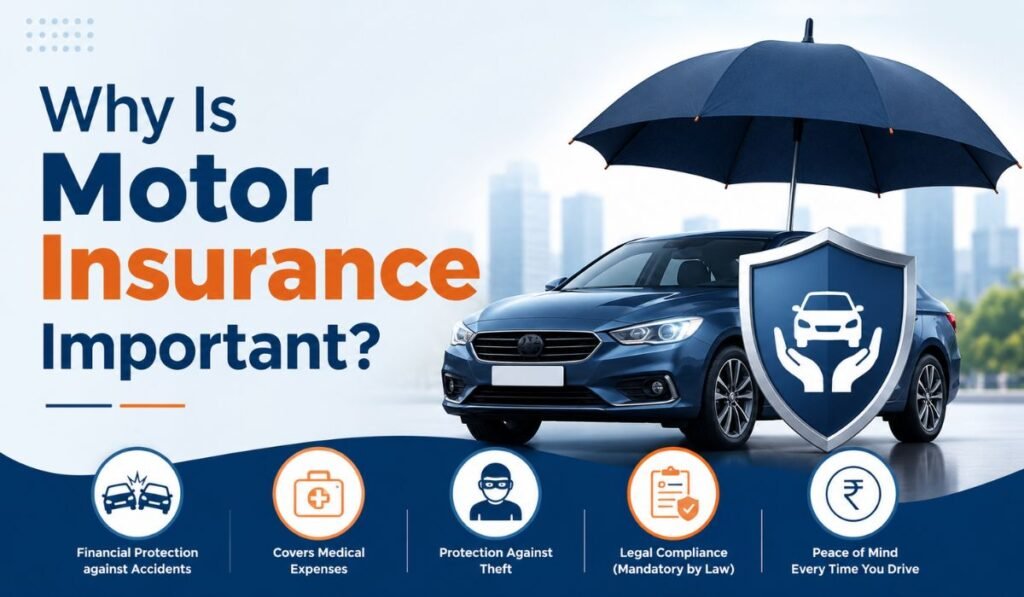
The significance of knowing vehicle coverage is greater than just following the law. There are a multitude of great factors why every automobile owner ought to provide sufficient defense.
Accident Protection
Accidents are unexpected events, and even drivers who take precautions make mistakes. Repairing a vehicle that has been damaged, treating injuries or compensating for any third party can amount to lakhs of rupee. A quality policy takes on these costs and keeps them from derailing your finances.
Theft Coverage
Secondly, car theft has been rising in many cities. The economically protection of comprehensive insurance pays you the value before your vehicle was stolen, as well as make it easier to replace the loss.
Natural Disaster Protection
Third, natural disasters – floods, earthquakes, typhoons, landslides – destroy vehicles within seconds. Many of the climate-related events have become more frequent and intense putting owners at increasing demand to protect against these risks around the world.
Third-Party Liability
Fourth, third-party liability coverage is for when your vehicle kills or injures a person and/or damages somebody’s property so that you are legally liable to pay. Compensatory damages that are ordered from a Court can be quite high especially in cases of bodily injury, and there may not be any limits on such damages.
Peace of Mind
Last but not least, the best Motor Insurance plan gives you complete peace of mind. Being sure you are covered financially lets you enjoy driving your vehicle instead of fearing the worst case. While difficult to quantify, this psychological advantage may be one of the most important elements of being adequately insured.
Types of Motor Insurance Policies
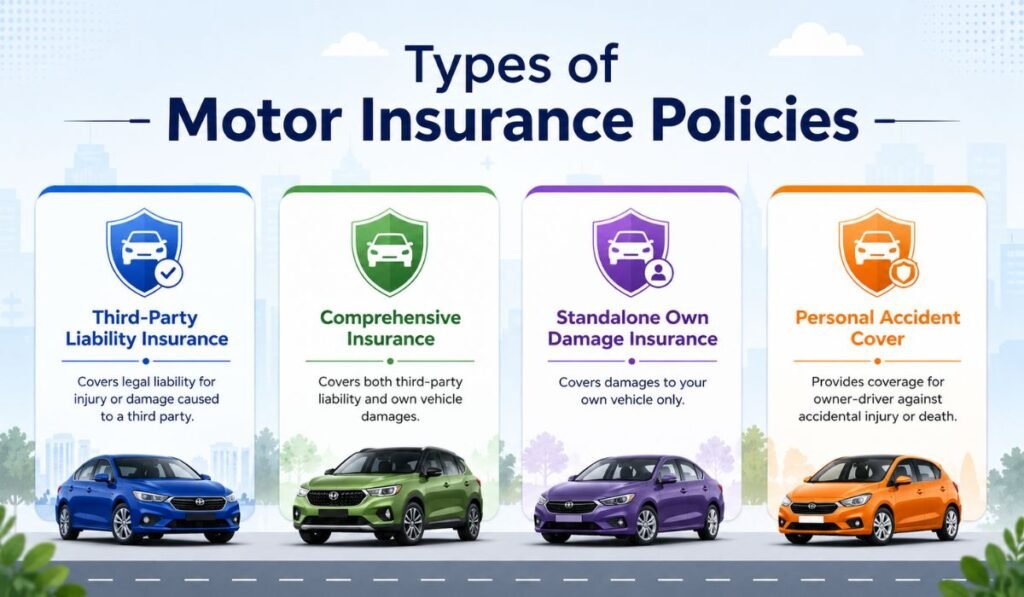
There are several types of Motor Insurance that can be found with a different level cover. Cognizing these groups is the essential to picking the most effective prepare for your particular scenarios.
Third-Party Liability Coverage
This is the most minimal, legally required protection. This is what kicks in when you injure another person or damage someone else’s vehicle or property. It does not, however, cover injury to your own car.
Third-party insurance is the most basic requirement to drive on public roads. Typically, it is the least expensive alternative because it is limited in its scope. This covers legal responsibilities but does not provide the policyholder with coverage for claims involving their own vehicle, explaining why so many owners take larger levels of protection.
Comprehensive Coverage
Comprehensive plans offer all-around protection. Third party liability coverage along with own damage cover due to accidents, theft, fire, vandalism and natural disaster. This is the default choice for fear-free vehicle owners.
Comprehensive Motor Insurance however is more expensive than just basic third party options but the additional cover it affords you makes it well worth paying for.This applies especially when it comes to your newer or particularly high-value vehicles. The premium on this sort of cover can be much higher, but many owners are happy to accept the additional cost for extensive coverage that protects against a wide range of risks.
Standalone Own-Damage Coverage
Standalone own-damage plans were introduced as a flexible offering, which covers damage to only your car itself. Usually sold in conjunction with a separate third-party policy, owners can tailor their coverage from multiple insurers and save.
This is for those owners who already have a long-term third-party policy and want to opt own-damage cover separately. Provides flexibility to adapt but necessitates tracking two different policy periods in order for coverage without interruption.
Pay-As-You-Drive Coverage
These plans, known as pay-as-you-drive plans and based on the most recent, usage-based model, determine premiums from actual miles driven. Many low-mileage drivers also benefit from lower premiums, making this a great option if you rarely use your vehicle.
It calculates cost based on telematics or self-declared mileage. This makes it repay, albeit in moderation and more-midline with the risk that certainly exists, being precedent-setting as one of the biggest breakthroughs we’ve seen for any type of modern vehicle protection.
Comparison of Policy Types
Here is a table to summarize the key difference between each of them types of Vehicle Protection, so you can pick which one is best suited for your needs.
| Feature | Third-Party | Comprehensive | Standalone Own-Damage | Pay-As-You-Drive |
| Third-party liability | Yes | Yes | No | Varies |
| Own vehicle damage | No | Yes | Yes | Yes |
| Theft protection | No | Yes | Yes | Yes |
| Natural disaster cover | No | Yes | Yes | Yes |
| Premium cost | Lowest | Higher | Moderate | Usage-based |
| Legal compliance | Yes | Yes | Only with TP policy | Yes |
| Best suited for | Budget-conscious | Most owners | Flexible buyers | Low-mileage drivers |
What Does Motor Insurance Cover?
The standard broad comprehensive policy covers a few possible happenings. When you know more about what your coverage includes, it can help you appreciate the true worth of your plan and avoid getting blindsided at claim time.
Most policies are based on accidental damage. Whether your car is damaged while crashing with another vehicle or when hitting a solid object (tree, wall, etc.), or even if it sustains damage in a multiple accident involving several vehicles, the insurance will pay you for repairs according to the conditions and deductibles mentioned in your contract.
Collision coverage covers you if your vehicle is totaled in a crash. Theft protection pays you if your entire vehicle is stolen and not recovered. This compensation is often based on the insured declared value (IDV), which is a figure best understood as the market price of your car at that moment when it suffered a loss.
The fire and explosion damage covers your losses from any loss you sustain due to a short circuit or accidental fire or explosions that occurred when your vehicle is moving and parked, if it damages or destroys your vehicle.
Comprehensive plans Typically cover natural disasters like floods, earthquakes, storms, cyclones,hurricanes and landslides. This protection has become more relevant to owners in risk-prone areas with the rise in frequency of extreme weather.
Another area where comprehensive has your back is against man-made disasters: riots, strikes, terrorism and criminal mischief all qualify for basic-comprehensive coverage.
Third-party liability protects you from being crippled by the legal losses of exceeding minimum compensation requirements in your jurisdiction if your vehicle injures, death or damages property to others by providing for the payment of their legal costs and any claims at law made against you.
It is mostly a part of owner driver insurance or available as add-on; Personal accident cover compensates you in case of disability / death by an accident to the insured vehicle.
What Is Not Covered?
All Motor Insurance policies contain some exclusions, which are situations in which the insurer will not pay a claim. This knowledge of limitations avoids misunderstanding and disappointment at the point when you needed protection the most.
Remember that progressive wear and tear is never covered. Normal wear and tear of components from normal use is considered to be a maintenance responsibility, not an insured event addressed by the policy.
General wear and tear due to mechanical or electrical failure that is not directly caused by an accident is excluded from standard coverage. These are considered servicing issues rather than insurable losses.
If you were driving while intoxicated or under the influence of drugs, then this completely voids any claim. Insurers apply this exclusion very rigorously and being intoxicated at the time of an incident will result in a total rejection.
Coverage is voided if you are driving without a valid license. To be covered, the driver must also have held a relevant, valid license (e.g. provisional, international) at the time of incident.
Driving a private vehicle for commercial use — including ride-hailing or transporting goods but not declaring this makes the policy void since it alters the risk profile that was contracted by the insurer.
Any damage beyond the borders of the geographical area defined in your policy is non-insured unless you have bought extended protection from travelling to other countries or regions.
Settlement does not cover consequential losses, which come about because of the indirect effects of an accident but do not concern direct physical loss or damage.
Insurance is designed to cover fortuitous and accidental events only, never coverage for intentional destruction exposed by the policyholder.
Understanding Add-On Covers
An add-on cover, or rider, refers to an extended coverage in your basic policy of the motor insurance. They require a more premium on top of the price but can really up your protection. These are the most beneficial add-ons for car owners on the market today.
One of the best insurance add-ons that you can opt for is zero depreciation cover or considerably known as bumper-to-bumper coverage. The insurance company typically reduces the amount it pays for your replacement part when it settles a claim by whatever depreciation has occurred between 2004 (when you bought the car) and 2020 (the year of the accident). Zero Depreciation gives you the total cost of your replaced parts, without any depreciation deduction to lower your claim and helps you gain maximally.
The engine protection cover protects your engine against damage due to water ingression, oil leakage or lubricant failure—situations that are not covered under regular plans. This is particularly beneficial in flood-prone regions where water damage can pose an actual threat.
Roadside Assistance Services: When you break down, roadside assistance services are there for you by offering towing, fuel delivery, tyre change service, jump-start battery help and on-site minor repairs. The book provides emergency assistance for when you’re log away from home.
A return-to-invoice cover will promise that if the vehicle is found to be a total loss or theft you will receive the full invoice value of your car including registration and taxes, as opposed to market value which can often differ considerably from actual purchase price (IDV).
A no-claim bonus protection allows you to keep your no-claim bonus once you had made a claim and you will be able to maintain the same low premium discount earned as compensation for several years of driving without an accident, injury or damage.
Consumables cover will pay out for consumable items, such as engine oil, nuts and bolts, screws and lubricants that are generally not included in a claim but can amount to a considerable sum on major repairs.
Key replacement coverage provides you with reimbursement for the cost of replacing lost, stolen, or damaged keys and lock systems — a surprisingly costly proposition in modern vehicles.
Tyre cover protects against damage or burst of tyres, which is usually excluded unless there is accompanying other accidental damage to the vehicle.
How Premiums Are Calculated
The premium you pay for Motor Insurance is based on a set of parameters that together indicate how risky the policyholder may be to insure. This understanding allows you to predict costs and ways to cut your premium negatively.
Premium amount: The most important measure here is IDV (insured declared value). This is the present market value of your car and this will form the basis for premium calculation as well as claim settlement. Higher IDV also translates into a higher premium but at the same time it also means you can get a bigger payout in case of total loss.
The following list consists of your car, and the premiums will depend on the brand and model of your vehicle. High-priced vehicles with expensive spare parts attract more bucks than economical models which cost less to repair or replace.
Pricing is impacted by the age of the vehicle because a vehicle that is older will depreciate, and may also hold varying degrees of risk. Since the IDV of a vehicle decreases with age, premiums will typically drop too.
For cars and two-wheelers, one of the factors is engine capacity, which is measured in cubic centimeters. Of course, larger engines typically also equate to a higher premium since chances are they are going to be more powerful, thus a high risk auto.
It depends on the location where you register the vehicle. Rural places that are less congested and have a lower rate of incidents tend to charge premiums more than urban vast majority.
How asured you have been in the past plays a big part. If you do not claim, your account will become clean and earn you a no-claim bonus; if you solicit claims regularly, they will make you more dangerous in the eyes of insurance companies and so your price rises at renewal.
Add-ons: The add-on covers you choose will be in addition to the base premium, but broadening your protection in a corresponding way allows you to adjust the cost-coverage ratio.
The No-Claim Bonus Explained
The no-claim bonus (NCB) is a reward for not claiming. The insurer provides you a discount on your own-damage premium at the time of renewal for every year that passes without any claim. That discount adds up during years when you don’t make a claim, which can ultimately save prudent drivers quite a bit over the long haul.
The table below shows how the no-claim bonus usually increases every year you successfully avoid making a claim.
| Claim-Free Years | No-Claim Bonus Discount |
| After 1 year | 20% |
| After 2 years | 25% |
| After 3 years | 35% |
| After 4 years | 45% |
| After 5 years | 50% |
The no-claim bonus is assigned to the policyholder and not the vehicle, which is an important thing to keep in mind. What this means is that, when you sell your vehicle and buy a new one, you can transfer the discount you’ve earned to the policy on the new car. Also, when you change insurers you can take your no-claim discount with you to the new insurer by getting an NCB certificate from your previous company.
A claim, no matter how small reduces your no-claim bonus to zero unless you purchased NCB protection as an add-on. Consequently, it may pay to go self-insured for lesser damages simply because claiming will mean losing discount that could be worth hundreds or thousands of dollars after several years.
How to Choose the Motor Insurance Right Policy
Choosing the best plan for your Motor Insurance requires a trade off between policy details, premium priced, and your circumstances. This is a simple guide to help you decide without being overwhelmed by an excess of choices.
The first step is to get honest with yourself on what you need. Think about your car’s age and worth, how often you drive, where you live, and what you can afford. A new luxury vehicle requires full coverage with multiple add-ons, while an old economy car is often best served by a basic plan.
Check the insured declared value of different insurers. While buying a new car insurance policy, opt not just for the cheapest premium but also avoid lowest IDV that leads to undervaluation of your vehicle in case total loss takes place.
Check out the claim settlement ratio of prospective insurers. This number represents the percentage of claims that an insurer accepts and pays. A high ratio indicates a more trustworthy provider and promise-keeper to policyholders.
Analyze the network of cashless garages. Having a broad network means you can have repairs done at garages that are partnered with your insurer, and you won’t have to pay upfront; the insurance firm pays the garage directly for their services.
Go through your policy document minutely and check for exclusions, deductibles and terms. Having a good grasp of the fine print prevents nasty surprises during claims at a time you least need it.
Only buy those riders that suit your needs, instead of buying all the available add-ons. While zero depreciation and roadside assistance are pretty generic that everyone can use, the others need to be selective based on your needs or situations.
Shop around with multiple insurers, but let price be a then-second consideration. Combining the cost with service quality, IDV and coverage scope, the cheapest solution may not be the best.
Step-by-Step Guide to Buying a Motor Insurance Policy
The process of buying vehicle protection has become exceedingly simple, with almost all aspects handled online. Now lets look at a straightforward order in which you caan buy Motor Insurance for your vehicle.
First, enter details about your car- Registration number, make/model/variant/year of manufacture/current odometer reading. You will likewise require identification from yourself to finish the application.
Check the websites of several insurers or a comparison website to get quotes. Fill in your details about your car and information accurately to get realistic estimates that match with your situation.
Compare Quotes: Compare based on coverage, idv, add-ons, claim settlement ratio and premium Narrow it down to two or three that fits your needs best and provides the greatest overall value.
Select the suitable add-ons as per your requirement and finalize the IDV in your selected plan. Check the revised whole premium again after these adjustments and then be sure that it is affordable for you that is providing enough protection.
Fill in the details required to complete your purchase and pay via a secure gateway The policy document is generated almost immediately after payment has been made, predominantly in e-mail.
Once you receive the policy document, verify its details carefully. Ensure vehicle information, coverage selection, IDV & validity period is correct If you notice a difference, report it straight away or you may run into issues when making a claim in the future.
Top 10 Motor Insurance Companies in India
Here’s a quick comparison of the top 10 motor insurance companies in India based on their claim settlement ratio, cashless garage network, and key customer benefits.
| 1 | HDFC ERGO General Insurance | 8,200+ | 99% | High CSR, Overnight Repairs |
| 2 | Royal Sundaram General Insurance | 3,300+ | 98.6% | Free Pick-up & Drop Service |
| 3 | Bajaj Allianz General Insurance | 4,000+ | 98.5% | Strong Network & Customer Service |
| 4 | Liberty General Insurance | 4,500+ | 98% | Competitive Pricing |
| 5 | IndusInd General Insurance (Formerly Reliance) | 8,200+ | 98% | Spot Claims up to ₹20,000 |
| 6 | Magma HDI General Insurance | 4,000+ | 96.6% | Spot Claims up to ₹20 Lakh |
| 7 | ICICI Lombard General Insurance | 5,900+ | 96.75% | Extensive Cashless Garage Network |
| 8 | Future Generali General Insurance | 3,500+ | 96.3% | 6-Month Repair Warranty |
| 9 | Shriram General Insurance | 2,000+ | 96% | Efficient Claim Processing |
| 10 | Universal Sompo General Insurance | 3,500+ | 96% | Zero-Paper Claim Process |
The Claims Process for Motor Insurance
The mere thought of Claiming Motor Insurance can seem daunting, but it is not as complicated as it looks once you get the hang of the process. Doing things correctly improves the timeliness of settlement and lowers risk for rejection by the insurance company.
Immediately following an incident, when it is safe to do so, isolate individuals involved in the incident. If there are any injuries or major damage in the accident, you should call the police right away and get a copy of their report (it is called an FIR) since this will be required for theft and serious accidents claims.
Alert your insurer immediately. Most corporations have time limits for building representations and, in truth, the faster you investigate an accident and notify your insurer of claim circumstances, the extra efficient the procedure will be executed (and the quicker any settlement can occur).
Document the scene thoroughly. Photograph the damage, an entire photograph of the boat damaged and any other types not having been noted. This damages your argument, and helps the surveyor assess it correctly.
Go to a network garage for cashless claims. The garage works with the insurer directly and the approved repair costs are settled between them, only requiring you to pay the deductible and any leftover expenses that aren’t covered by insurance.
If you need to make a claim for reimbursement, get the garage of your choice to do the repairs and keep all bills and receipts, then submit them to the insurer for reimbursement once it has been claimed.
An appointed surveyor from the insurers inspects works damage. After that, if approved, the insurer pays either the garage or you depending on the type of claim. Hold onto copies of everything for your records in case questions come up later.
Documents Required for Claims
All it takes is the right paperwork — without the paperwork ready, your claim may take ages to get settled. The table below provides details on the documents needed for various claim situations under a standard policy.
| Claim Type | Required Documents |
| Accident damage | Policy copy, driving license, registration certificate, claim form, repair estimate, damage photographs |
| Theft | Policy copy, FIR, registration certificate, original keys, no-trace report, driving license |
| Third-party | Policy copy, FIR, driving license, court documents, witness statements |
| Natural disaster | Policy copy, registration certificate, damage photographs, claim form, repair estimate |
Common Mistakes to Avoid
However quite a few policyholders sabotage their own protection via avoidable mistakes. And knowing those pitfalls makes you competent to sustain your Motor Insurance cover while you continue the ownership.
One of the most common problems that I have observed is purchasing a policy only because it has the lowest premium often time leads to paying for something that is lacking in required coverage. The lowest price might come at the cost of low IDV, high deductibles, or even incomplete coverage which is expensive when you need to raise a claim and find out the dark spots.
If you do not disclose the truth when buying a policy, it can end up being worthless. One of the most important things to remember is that you should always give accurate details regarding your vehicle, how it was used, and what type of history your vehicle has so that there will be no issue related to damage claims.
A lapse, even for a short while, in your policy can mean both legal penalties and you losing all that no-claim bonus you built up. Always renew on time, preferably before expiry, to avoid any lapse in coverage and losing your well-deserved discount.
One brings false expectations where the policy document is not regard and the exclusions. Review the terms in detail so you have greater awareness of what is and is not covered prior to an event occurring.
This becomes problematic because having a low enough IDV to keep your premiums down means that if you have a total loss, the amount you will receive is insufficient. There is therefore selecting an IDV that safely mirrors your car’s real market worth.
Neglecting useful add-ons that fit your situation causes you to miss out on protection which costs you, so much more than what the premium will be in certain perils like flooding or engine damage.
Delay in intimating the claim can lead to rejection. That you immediately notify your incidents so as not to fall outside the alert period of the insurer and continue to enjoy this right.
Renewing Your Policy
Renewals within deadlines are crucial to continued protection. An expired policy will not only leave you vulnerable to legal action but could also mean the loss of your no-claims bonus if the gap exceeds what is termed an ‘unsustainable grace period’, as outlined by your insurer.
Use your Motor Insurance renewal date as a chance to reevaluate. Considering your car may have deteriorated in value, the IDV has to be depreciated. Similarly, you might want to add or delete riders based on your needs and driving habits.
Use your existing insurer’s renewal quotes as a base to find competing offers. Do not be fooled as loyalty does not always offer the most competitive price and it has never been easier to switch providers at renewal (and with your no-claim bonus fully transferable too).
Attach your reminders way before the actual expiry date so that you do not risk missing out. Most insurers have the option to get auto-renewal so that you do not fall out of coverage, but be sure to read the terms of anything before opting-in to avoid any unwanted automatic debits.
If your insurance has already lapsed, immediately renew it. Be aware that if your policy has lapsed, you may have to have the vehicle inspected, and an extended gap could see your no-claim bonus permanently forfeited – a very real cost saving loss.
Two-Wheeler vs Four-Wheeler Coverage
Although the essence of Motor Insurance for both is similar, there are many differences in the way protection works for two-wheelers and four-wheeler that you must be aware of.
Higher premiums on four-wheelers are due mainly to higher replace- or-repair costs but two-wheelers tend to be cheaper, hence lower premiums. But two wheelers are more vulnerable to theft and accidents, aspects that are already taken into consideration in the pricing of the risk by insurers.
In general, four wheeler coverage is broad in scope as compared to two wheelers because many more add-ons are offered and against which a higher premium is charged reflective of both the much larger value and repair costs associated with most cars and all other classes of vehicles.
Two-wheelers are also not left out when it comes to long-term policies, as there are several multi-year third-party coverage that help you get away from frequent renewals. Four-wheelers also have such long-term options, especially for new vehicles.
In all cases of vehicle type, the same basic advice applies: know your needs, shop around, understand the terms and buy coverage to meet your actual need for protection while not overspending on unnecessary insurance.
The Role of Technology in Modern Coverage
Technology has changed how vehicle protection is purchased, administered and claimed on it. Now that it has gone online, you can compare policies and purchase or renew in minutes without any paperwork and time wasting agent visit.
These technologies also play a material part in telematics devices and mobile apps which facilitate usage-based pricing by tracking driving behaviour to provide personalised premiums. The cost of coverage is then not based on general statistics but rather the actual data behind safe drivers.
AI speeds up claims processing, with minor claims processed instantly via image damage assessments; some insurers are paying out quickly. You just need to upload images of the damage and the algorithms calculate repair costs in minutes.
Now, digital policy documents saved on the phone are valid as a law streamlining that policy benefits can be drawn without carrying hard copies of certain documents. This readily available documentation eliminates the chances of incurring fines associated with forgetting paperwork in the event of a traffic stop.
And such technological breakthroughs nowadays afford protection to your vehicle than ever before easier, more transparent and efficient which in turn equips the owner to decide wisely about their Motor Insurance with confidence and ease.
Tips to Lower Your Premium
Getting enough coverage is important, but there are some perfectly valid ways to lower your premium without sacrificing the protection you depend on.
By maintaining a clean claims history, you’ll build and keep that no-claims discount —or claim-free years of driving– which gives you sizeable discounts over the years and rewards your responsible driving year-on-year.
Set up theft prevention gadgets authorized through trusted entities. Discounts are often offered by insurers for vehicles that have certified security systems which minimize the risk of theft.
Opt for a voluntary deductible and you agree to pay part of any claim yourself, but the policyholder pays a lower premium. This makes sense if you are such a careful driver that you wont be claiming too often.
Do not qualify for small refunds readily paying from your pockets. Generally speaking, keeping your no-claim bonus is worth more than any small claim.
Do not automatically renew with your insurer – compare quotes at renewal. However, more competition among providers can result in improved deals for plans with similar coverage.
If you have multiple vehicles, bundle policies as some insurers allow you to insure more than one vehicle within the same relationship and offer a discount for multiple lines of coverage.
Be mindful of membership in well-known automobile associations as in some instances members can receive premium discounts with affiliates who have formed a partnership with an insurance company.
Frequently Asked Questions
Is Motor Insurance mandatory by law?
Yes, third party liability is required by law to drive a vehicle on public roads, at the very least. Doing so without valid coverage can also lead to fines, the loss of your license, and other consequences. Although legally required, third party coverage only covers the basics of what you will need—comprehensive coverage is strongly recommended to protect against a wider variety of risk.
What is the difference between third-party and comprehensive coverage?
Third-party coverage only protects for damages or injuries you cause to someone else and not your own car. Comprehensive coverage also covers everything that third-party insurance will cover, in addition to your own vehicle getting damaged in a car accident, stolen or damaged as a result of fire or natural disasters. Comprehensive plans provide a much more extensive coverage and come at a premium level, so they are appropriate for most owners.
What is the insured declared value?
The insured declared value, commonly known as IDV is the present market worth of your automobile and represents the highest amount payable by the insurer in case of total destruction or theft. It becomes the foundation on which premium is calculated and claims are settled. Higher IDV translates to a higher premium but also the maximum coverage when you need it.
Can I transfer my no-claim bonus to a new vehicle?
YES, the no-claim bonus is yours and not attached to the vehicle. You switch from your old car to a new one, and transfer the no-claim bonus that you have accumulated. It can also be carried over to a new insurer by getting your old provider to issue an NCB certificate.
What happens if my Motor Insurance policy lapses?
A lapsed Motor Insurance policy means that you are legally exposed and cannot be protected. If you drive without valid coverage, then you could be penalized. And if the gap is longer than the grace period, you will lose all your no-claim bonus. More often than not, a vehicle inspection needs to be completed prior to a lapsed policy being renewed therefore it is best practice to renew insurance before expiry.
Are natural disasters covered under Motor Insurance?
They cover natural calamities like floods, earthquakes, storms cyclones and landslides under a single plan. Such protection is not included in basic third party coverage. Increasing weather extremes make this an important consideration for those people living in a disaster-prone area as they will want to consider comprehensive coverage.
What is zero depreciation cover?
Zero depreciation cover is an add-on that you will receive the full cost of parts replaced during a claim without having to incur any depreciation. Generally, insurers subtract depreciation on components – which scales your payout again. This rider will give you the most money for your claim and is also especially important for newer vehicles that contain expensive parts.
How is the premium calculated?
Your premium varies based on a number of factors such as your insured declared value, vehicle make and model, engine capacity, age of the vehicle, area where you live in the country, history of claims made by you and any add-ons selected. Each factor indicates the amount of risk involved and will ultimately impact the final premium that you need to pay.
Should I make a claim for minor damage?
In fact, if the damage is less than what your no-claims bonus discount would save you, it can be more economical to pay out of pocket. If you make a claim your no-claim bonus drops to zero unless you pay for NCB protection which will often cost far more in lost discounts than the minor claim could possibly have contributed.
Can I buy a Motor Insurance policy online?
Indeed, buying car insurance online has arrived. You can compare quotes, tailor coverages, and buy insurance in minutes from insurer websites or comparison sites. The digital policy docs are legally valid, thus making the entire procedure hassle-free, speedy and 100% paperless.
What documents do I need to file a claim?
Depending on the type of claim you may also have different documents that are required but usually include a copy of your policy, driving license and registration certificate along with a filled up claim form and damage photos. In addition to FIR, theft claims must additionally submit a no-trace document version and for third-birthday birthday celebration claims, court docket documents and witness statements may be required if such proceedings are initiated.
Is roadside assistance worth adding?
An optional add-on that everyone can benefit from is roadside assistance in case of breakdown, which includes technicians to tow your vehicle to a service point and delivering fuel or jump-starting the battery if it dies, along with minor repairs on-site. This is an inexpensive rider but if you often travel very long distances or want the peace of mind in case of emergencies, it is a small investment that makes sense.
Conclusion
Coverage to safeguard your car is what you need, — it is not just a legal formality but a necessary protection for pleasure or financial setback. This guide walks through the different types of plans, what they do and don t cover, how premiums are calculated, whether add ons are worthwhile, as well as the nitty gritty around buying, claiming and renewals.
A good Motor Insurance policy is one that gives a right balance between premium and full cover that meets the different protection needs depending upon your vehicle type, usage patterns and budget. This understanding will help you avoid some common mistakes related to your coverage so that you can make confident, educated decisions on it — ones that are in your best interests now and for years to come.
In addition, the easiest and most transparent vehicle protection buying and managing experience has arrived as technology reshapes the landscape. Make use of the online comparison platforms, scrutinise insurers per their claim settlement ratios and garage networks, choose add-ons that address your genuine needs instead of simply inflating your premiums without reason.
In the end, a good Motor Insurance plan is something you can approach with confidence; because if anything happens down the road, you’ve got financial protection behind you. Keep reviewing your coverage, renew it on time, treat your policy as a must-have part of every trip. A car is an asset and a big investment so it is prudent to safeguard that risk with the right Motor Insurance, once the vehicle will take care of you for many years to come.